Volvo Patented the Three-Point Seat Belt in 1959, Then Opened the Patent to Every Rival It Had
Nils Bohlin came from building ejection seats for fighter aircraft, and he solved the seat belt in about a year. Volvo then did the thing companies almost never do with a patent that valuable: it made the design free to use, on the grounds that keeping it would cost lives.
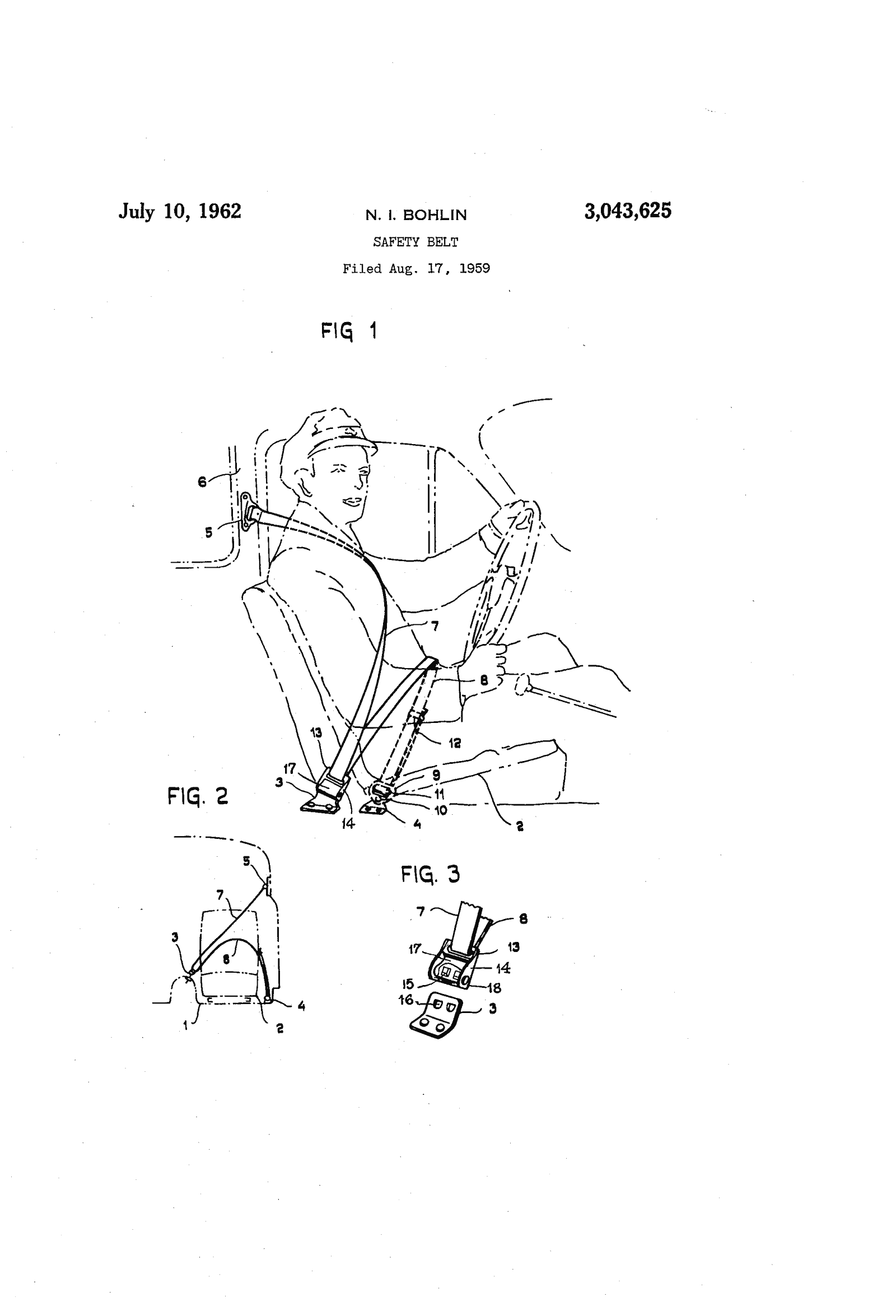
US3043625 was filed on August 17, 1959, with Nils Ivar Bohlin named as inventor and Volvo AB as assignee. The Patent Office title is Safety Belt. It describes the three-point belt that is in essentially every car on the road, and the interesting part of its history is not the engineering. It is what Volvo chose to do with the patent afterward.
What came before it was worse than nothing
Cars in the 1950s were mostly sold with either no belt or a two-point lap belt, a strap across the abdomen.
The lap belt keeps an occupant in the vehicle, which matters. What it does not do is restrain the upper body. In a frontal collision the torso pivots forward around the belt, which sends the head and chest into the steering wheel, the dashboard, or the windshield. Worse, the entire deceleration load concentrates on the soft tissue of the abdomen, and at speed a lap belt alone can cause severe internal injuries and spinal damage. The pattern was recognized clearly enough that clinicians gave it a name.
There were diagonal belts too, running across the chest, and they had the mirror problem. They restrained the torso but let the body slide forward underneath the strap.
Neither belt was worthless. Both were incomplete in a way that could produce its own distinct injuries.
An engineer from the ejection seat business
Volvo hired Bohlin in 1958 as its first chief safety engineer. He came from Saab, where he had worked on ejection seats for fighter aircraft.
That background matters more than it sounds like it should. Restraining a pilot being fired out of an aircraft is a problem of holding a human body against enormous force through the strongest parts of its skeleton, without the person needing to think about it. Bohlin had spent his career on exactly the question a car seat belt poses.
His stated constraints were tight. The belt had to restrain both the upper and lower body. It had to put the load into the parts of the skeleton that can take it, meaning the rib cage and the pelvis, rather than the abdomen. And it had to be fastenable with one hand, in one motion, by an ordinary person who was not thinking about safety, because a belt people find awkward is a belt that does not get worn.
The last constraint is the one that separates a working design from a good idea.
The geometry
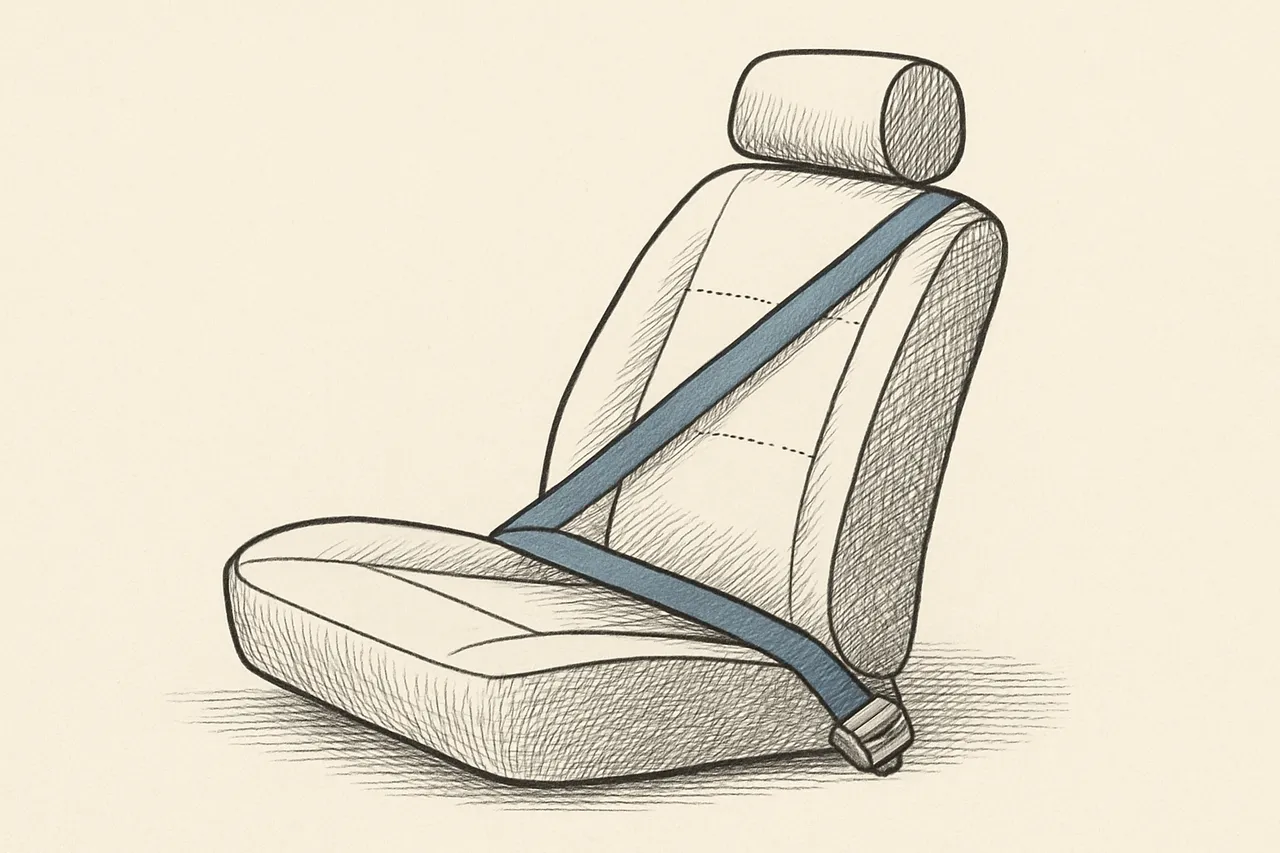
Bohlin's answer is the V shape everyone now takes for granted. One strap runs diagonally across the chest from the shoulder, a second runs across the pelvis, and both terminate at a single buckle anchored low, beside the seat.
The low, offside anchor point is the crucial detail. It means the whole assembly stays under tension across the two skeletal structures that can absorb a crash load, and it means the belt cannot ride up off the pelvis onto the abdomen. It also means the driver reaches over one shoulder, pulls down and across, and clips it, in a single continuous motion, with either hand.
Volvo put it in production cars in 1959, in the Amazon and the PV544, sold first in Sweden.
Giving it away
A patent on the only genuinely effective seat belt design, at the moment the entire world was buying cars, is close to the most valuable thing an automaker could hold.
Volvo made it open, allowing other manufacturers to use the design without paying for it. The reasoning the company has given consistently since is that the invention was worth more as a standard than as an advantage, and that restricting it would have meant people dying in other companies' cars for no reason but licensing revenue.
It is worth being precise about what this was. Volvo did not fail to enforce a patent or let it lapse by accident. It held a valid patent on a life-saving mechanism during the exact window when it could have extracted the most from it, and declined.
Estimates of the resulting death toll avoided are necessarily rough, and the figure most often repeated is that the design has saved more than a million lives. Treat that as an order of magnitude rather than a count. The direction is not in question. Three-point belts are mandatory equipment across the developed world and have been for decades, and every one of them is a descendant of this patent.
Bohlin received the Volvo company's own recognition, was inducted into the National Inventors Hall of Fame in 2002, and died the same year.
The belt was one of two ideas aimed at the same few milliseconds of a crash. The other was a cushion that inflates before the occupant arrives, patented in 1952 and then ignored for twenty-five years. Working out how much force a body can absorb, and where, required its own grim apparatus: see the crash test dummy.
See the original
The full text and figures of US3043625 are on Google Patents.
Related stories
The 1868 Patent Behind the First Successful Typewriter Had Its Keys in Alphabetical Order. QWERTY Came Later, and Nobody Fully Agrees Why.
Christopher Latham Sholes and two partners patented a typewriter in Milwaukee in 1868 with keys arranged like a piano, roughly in alphabetical order. Over the next several years the letters were shuffled into QWERTY. The popular explanation for that is a distortion of a better one.
Read the story →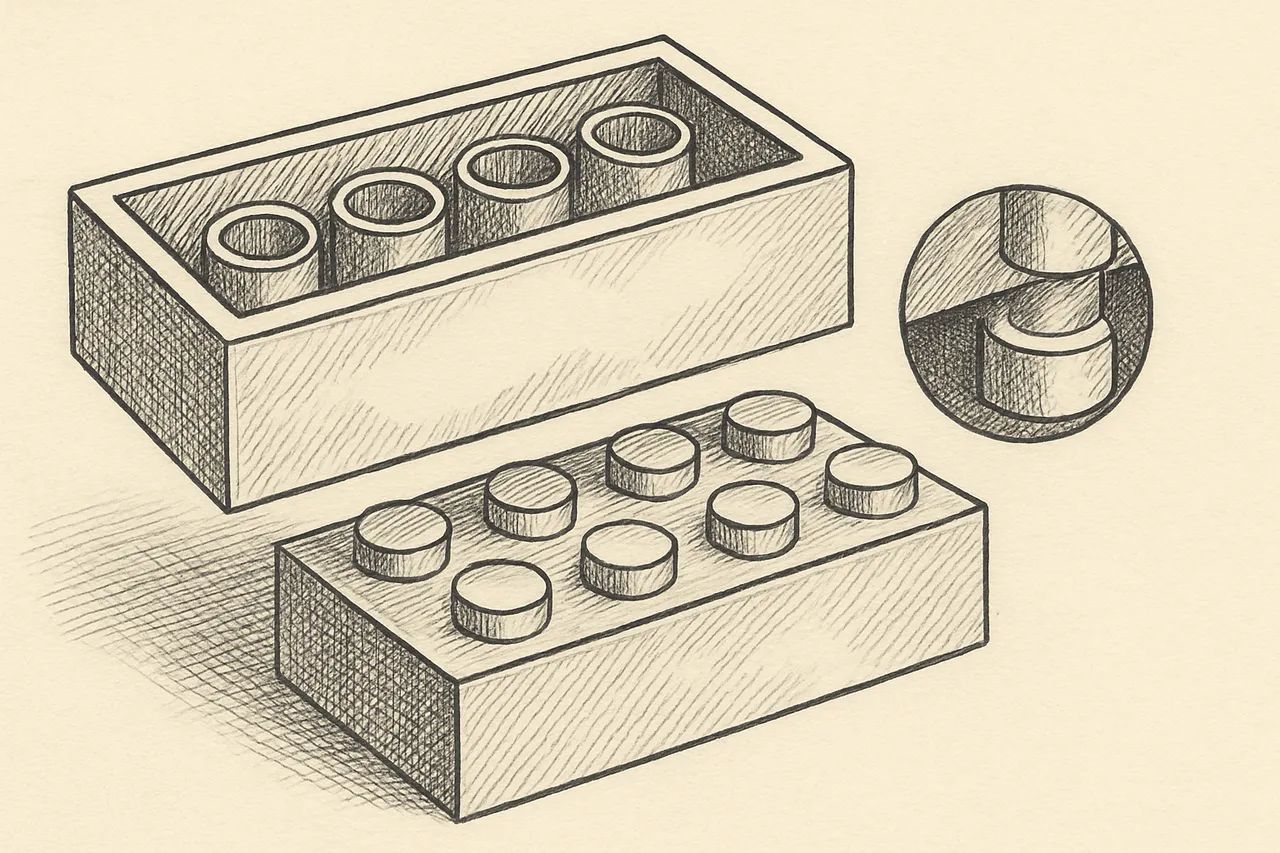
LEGO Bricks Were on Sale for Nine Years Before They Held Together Properly. The Fix Was a Row of Hollow Tubes.
The first LEGO bricks had studs on top and an empty space underneath, so models tended to come apart when you picked them up. Godtfred Kirk Christiansen's 1958 design put tubes inside the brick, and a brick molded that year still fits one molded today.
Read the story →
Clarence Birdseye Watched Inuit Fishermen Pull Fish From a Hole in the Ice and Worked Out Why Frozen Food Tasted Bad
Frozen food existed long before Birdseye and it was considered close to inedible. What he figured out in Labrador is that the problem was never freezing. It was freezing slowly, and the difference comes down to the size of the ice crystals.
Read the story →
Super Glue Was Discovered Twice by the Same Man, and He Threw It Out Both Times
Harry Coover found cyanoacrylate in 1942 while trying to make gun sights, and dismissed it for sticking to everything. He ran into it again in 1951 doing jet canopies. It took nine years and a second accident before anyone recognized that sticking to everything was the product.
Read the story →