LEGO Bricks Were on Sale for Nine Years Before They Held Together Properly. The Fix Was a Row of Hollow Tubes.
The first LEGO bricks had studs on top and an empty space underneath, so models tended to come apart when you picked them up. Godtfred Kirk Christiansen's 1958 design put tubes inside the brick, and a brick molded that year still fits one molded today.
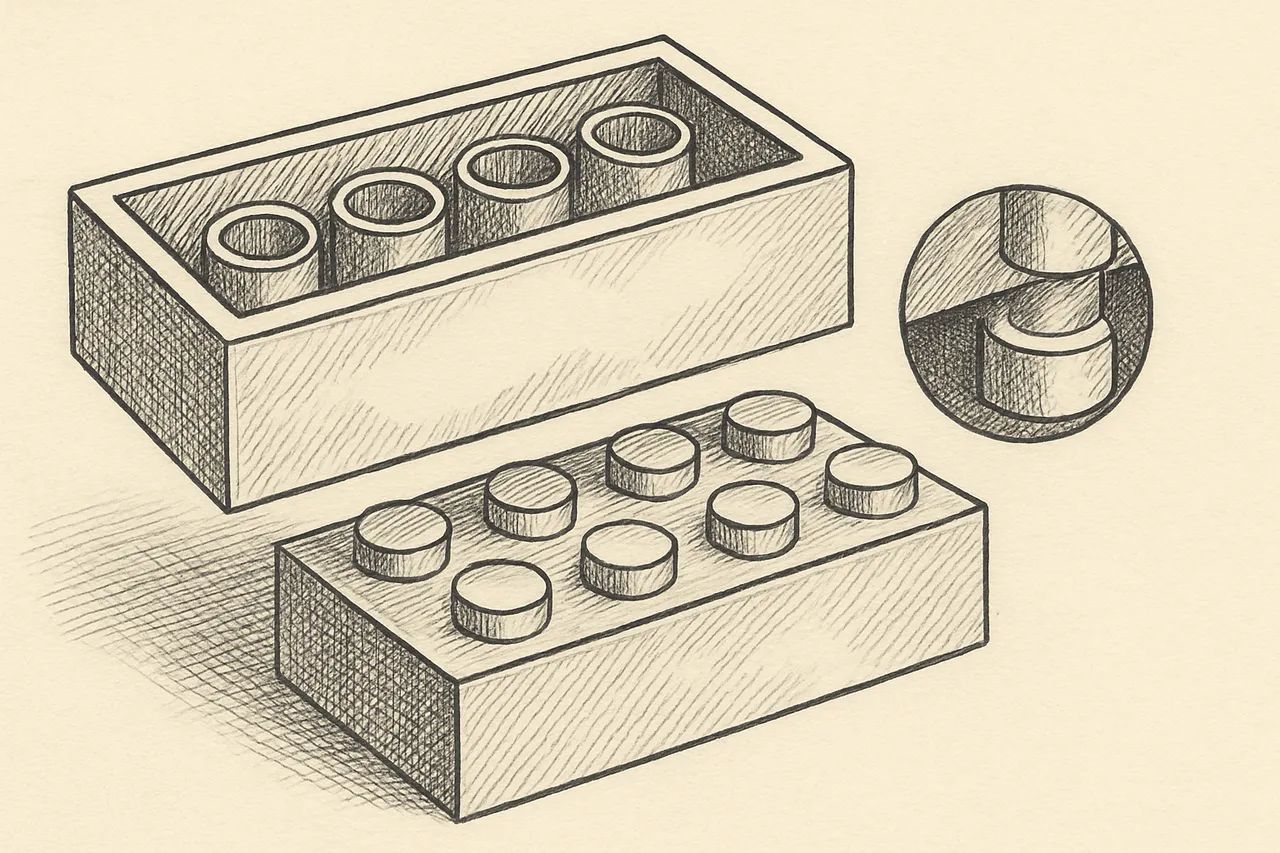
US3005282 was filed in the United States on July 28, 1958, by Godtfred Kirk Christiansen of Billund, Denmark, and granted in 1961. The title is Toy Building Brick.
The plastic brick already existed when this was filed. The patent fixes the reason it did not work very well.
The brick before the patent
The LEGO company was started by Ole Kirk Christiansen, a carpenter in Billund who made wooden toys through the 1930s. The name comes from the Danish leg godt, meaning "play well."
In 1949 the company began selling plastic bricks it called Automatic Binding Bricks. They were closely modeled on the Self-Locking Building Bricks sold in Britain by Kiddicraft, a company run by Hilary Page. They had studs on top and a hollow underside.
The hollow underside was the weak point. When an empty-bottomed brick sits on a row of studs, the only thing holding it is the contact between the studs and the inside of the brick's outer walls. That grip is light and depends heavily on the fit at the edges. A model built that way stays together on a table and tends to fall apart when a child lifts it, which is a real problem for a toy whose whole purpose is to be built, picked up, and played with.
The early plastic bricks were not a clear commercial success, and this is a large part of why.
The tubes
Godtfred, Ole's son, worked through a set of possible solutions in the late 1950s. The patent is interesting to read because it shows several of the alternatives, not only the one the company chose.
The design that won puts hollow cylindrical tubes along the center of the brick's underside, sitting in the gaps between the rows of studs.
Consider what a stud on the brick below now touches. It is no longer resting against a single wall. Each stud ends up pressed at three points, against the outer walls and a tube, or against a wall and two tubes. The load is spread around the stud instead of pushing on one side of it.
The grip itself comes from the plastic flexing a tiny amount as the brick is pressed down. The tube and the wall give very slightly, then push back against the stud. For that to hold firmly without being impossible for a child to pull apart, the parts have to be molded to extremely fine tolerances, and the company has spent decades refining its molds to keep that fit consistent. LEGO's own name for the result is clutch power.
Why this is the one that mattered
The tube design became the standard, and the company kept it. A brick made in 1958 still connects to one made now. That backward compatibility is an engineering decision with an enormous commercial consequence: every new set is sold into homes that already hold boxes of old bricks, and all of them work together.
The material changed along the way. Early bricks were made of cellulose acetate, which could warp and lose color. The company switched to ABS plastic in 1963, which is harder, more stable, and holds its dimensions, and which is what the bricks are still made of.
When the patent ran out
Patents expire, and the ones on the basic brick did. Other manufacturers began making bricks that fit LEGO bricks.
LEGO fought this in courts in several countries, arguing that the shape of the brick should be protected as a trademark, which unlike a patent can last indefinitely. In 2010 the Court of Justice of the European Union ruled against the company. Its reasoning was that the shape of the brick is a technical solution to a technical problem, and technical solutions are what patents are for. A company cannot extend a patent forever by calling the invention a brand.
That outcome follows the logic of the system closely. Christiansen solved a genuine engineering problem, the company held exclusive rights to the solution for years and built a very large business on it, and afterward the design became available to everyone. The thing that made the brick work is exactly what made it impossible to own permanently.
See the original
The full text and figures of US3005282 are on patents.us.
Related stories
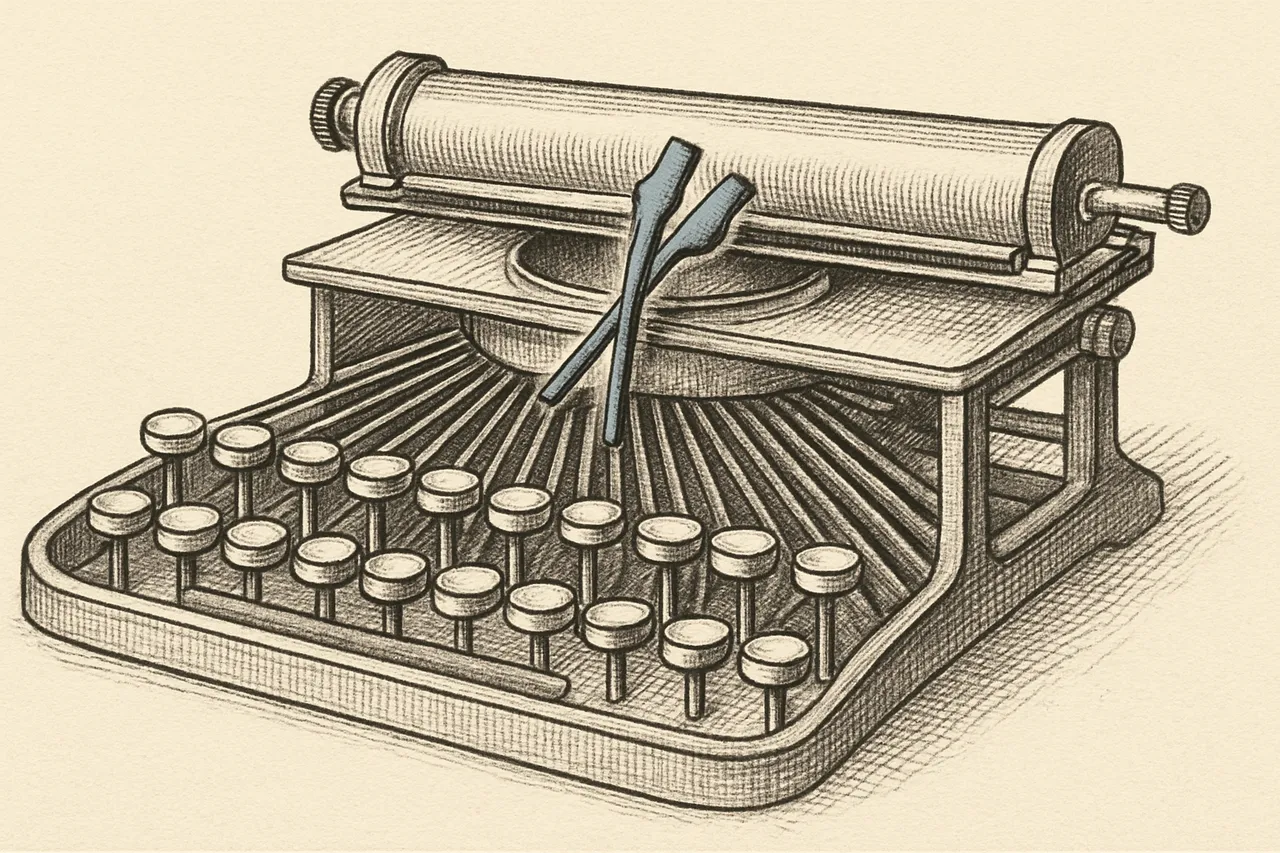
The 1868 Patent Behind the First Successful Typewriter Had Its Keys in Alphabetical Order. QWERTY Came Later, and Nobody Fully Agrees Why.
Christopher Latham Sholes and two partners patented a typewriter in Milwaukee in 1868 with keys arranged like a piano, roughly in alphabetical order. Over the next several years the letters were shuffled into QWERTY. The popular explanation for that is a distortion of a better one.
Read the story →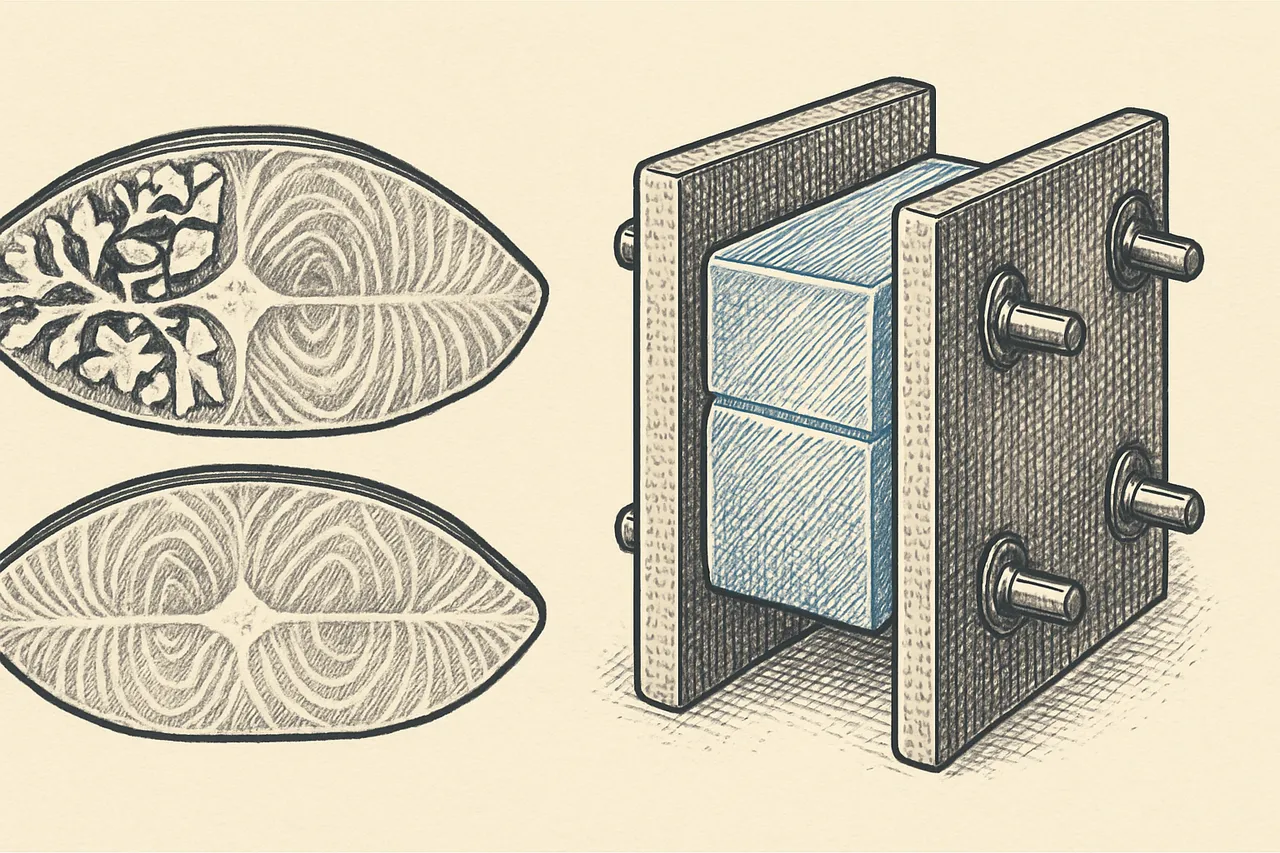
Clarence Birdseye Watched Inuit Fishermen Pull Fish From a Hole in the Ice and Worked Out Why Frozen Food Tasted Bad
Frozen food existed long before Birdseye and it was considered close to inedible. What he figured out in Labrador is that the problem was never freezing. It was freezing slowly, and the difference comes down to the size of the ice crystals.
Read the story →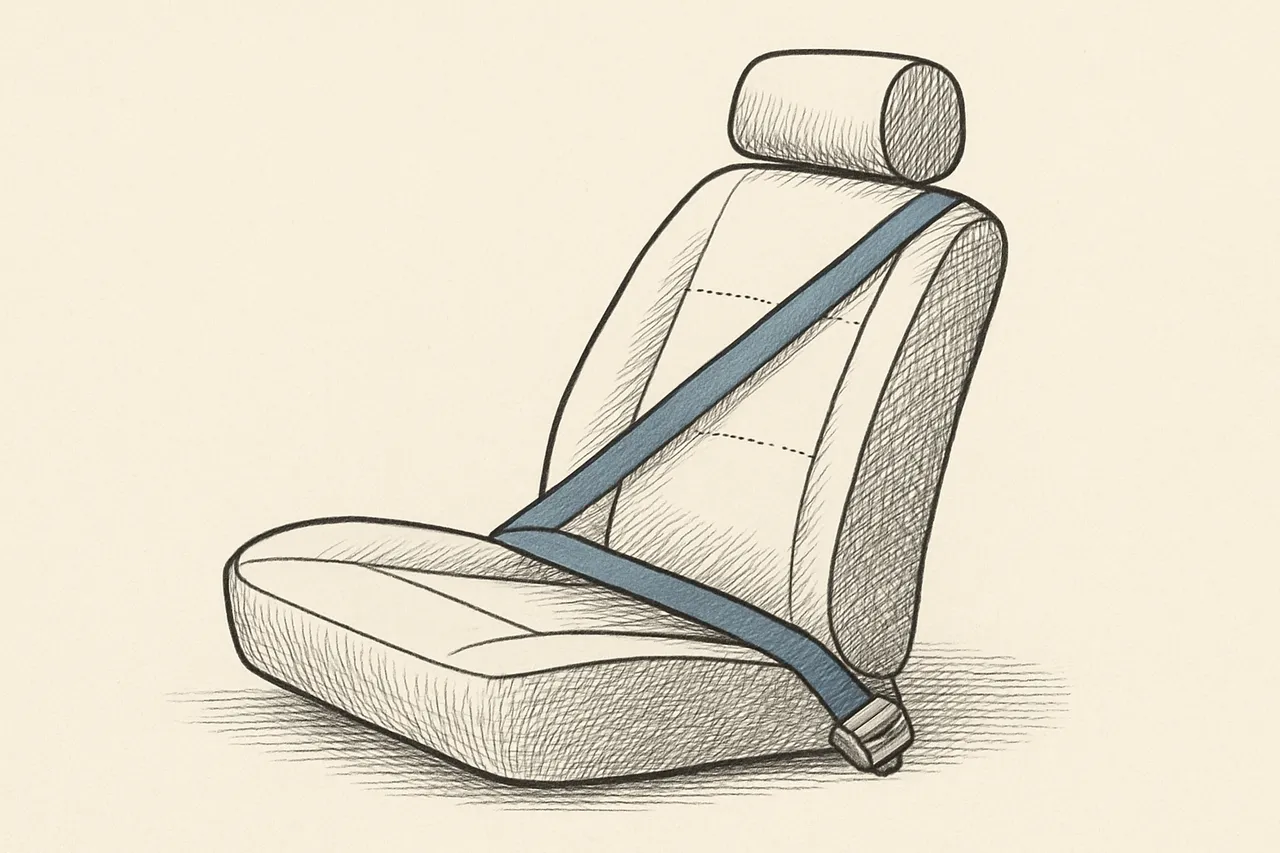
Volvo Patented the Three-Point Seat Belt in 1959, Then Opened the Patent to Every Rival It Had
Nils Bohlin came from building ejection seats for fighter aircraft, and he solved the seat belt in about a year. Volvo then did the thing companies almost never do with a patent that valuable: it made the design free to use, on the grounds that keeping it would cost lives.
Read the story →
Super Glue Was Discovered Twice by the Same Man, and He Threw It Out Both Times
Harry Coover found cyanoacrylate in 1942 while trying to make gun sights, and dismissed it for sticking to everything. He ran into it again in 1951 doing jet canopies. It took nine years and a second accident before anyone recognized that sticking to everything was the product.
Read the story →