The Fourth Marx Brother Patented a Heart-Monitoring Wristwatch in 1969
Zeppo was the Marx Brother who played it straight on screen and kept the family car running off it. Decades before smartwatches, he and an engineer patented a wrist unit that buzzed and sounded an alarm when a heart patient's pulse went wrong.

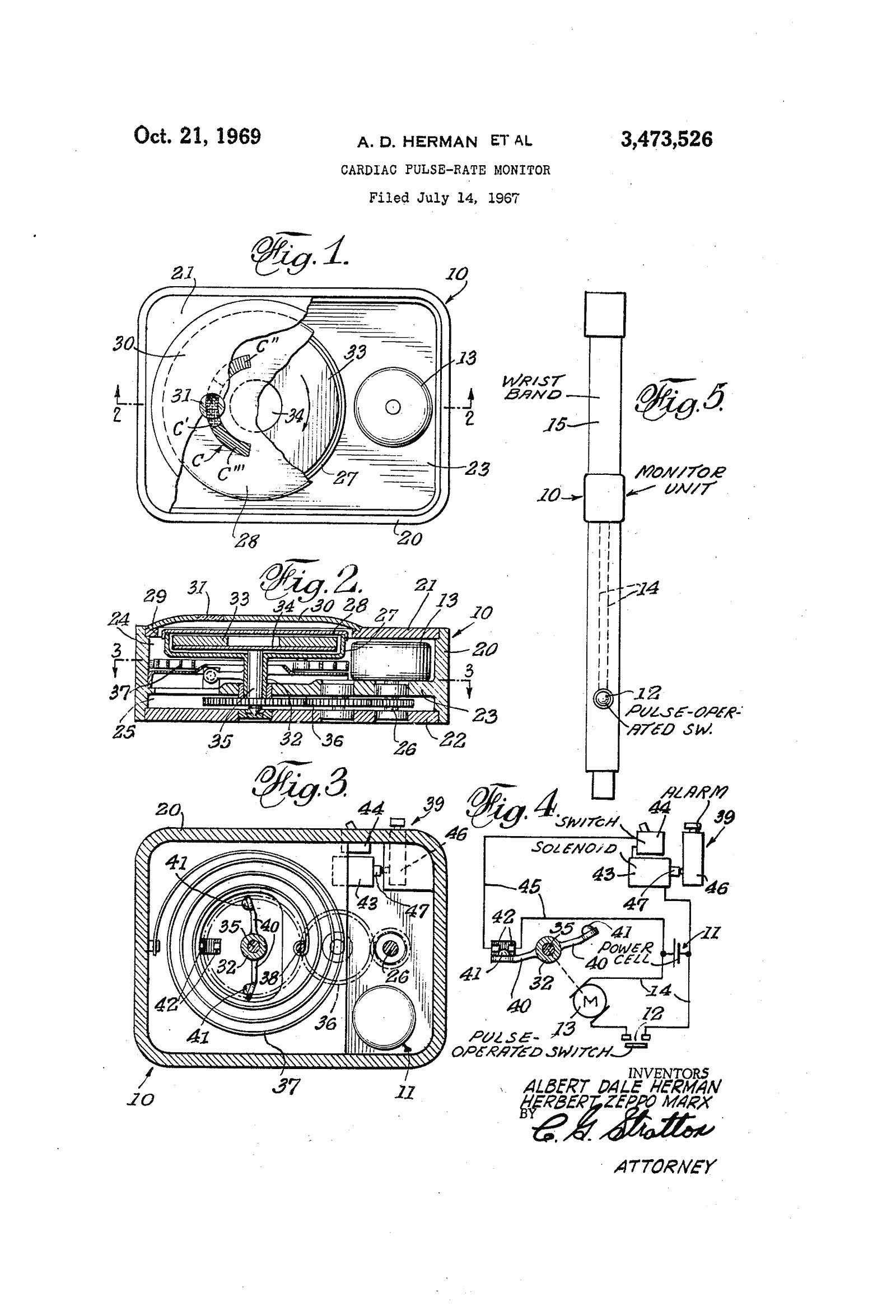
US3473526 was filed on July 14, 1967, and granted on October 21, 1969. The title is "Cardiac Pulse-Rate Monitor." The inventors are Albert Dale Herman of Encino and Herbert Zeppo Marx of Palm Springs, California, and it was assigned to a company called Lifeguard Watch of Beverly Hills.
Herbert Zeppo Marx is Zeppo, the youngest of the Marx Brothers, the straight man in their early films.
The mechanical Marx
Zeppo left the act in the early 1930s, and his talents had always been more mechanical than comic. He was the brother who kept the family car running. During the Second World War his firm, Marman Products, machined parts for the war effort, among them the Marman clamps that held the atomic bombs inside the B-29s Enola Gay and Bockscar.
Later in life he turned to medical devices.
A watch that listens to your heart
The 1969 patent describes a unit worn "in the manner of a wristwatch." A switch on the inside of the band rests against the pulse and closes with each beat. Each closure drives a small electric motor, run from a tiny battery, which turns a permanent magnet. The magnet drags on a housing held in its normal position by a hairspring.
When the pulse is normal, the housing stays where it belongs. When the rate, strength or rhythm swings too far, the housing moves, and the device gives what the patent calls an "audible and vibratory warning" to a person with "cardiac impairment."
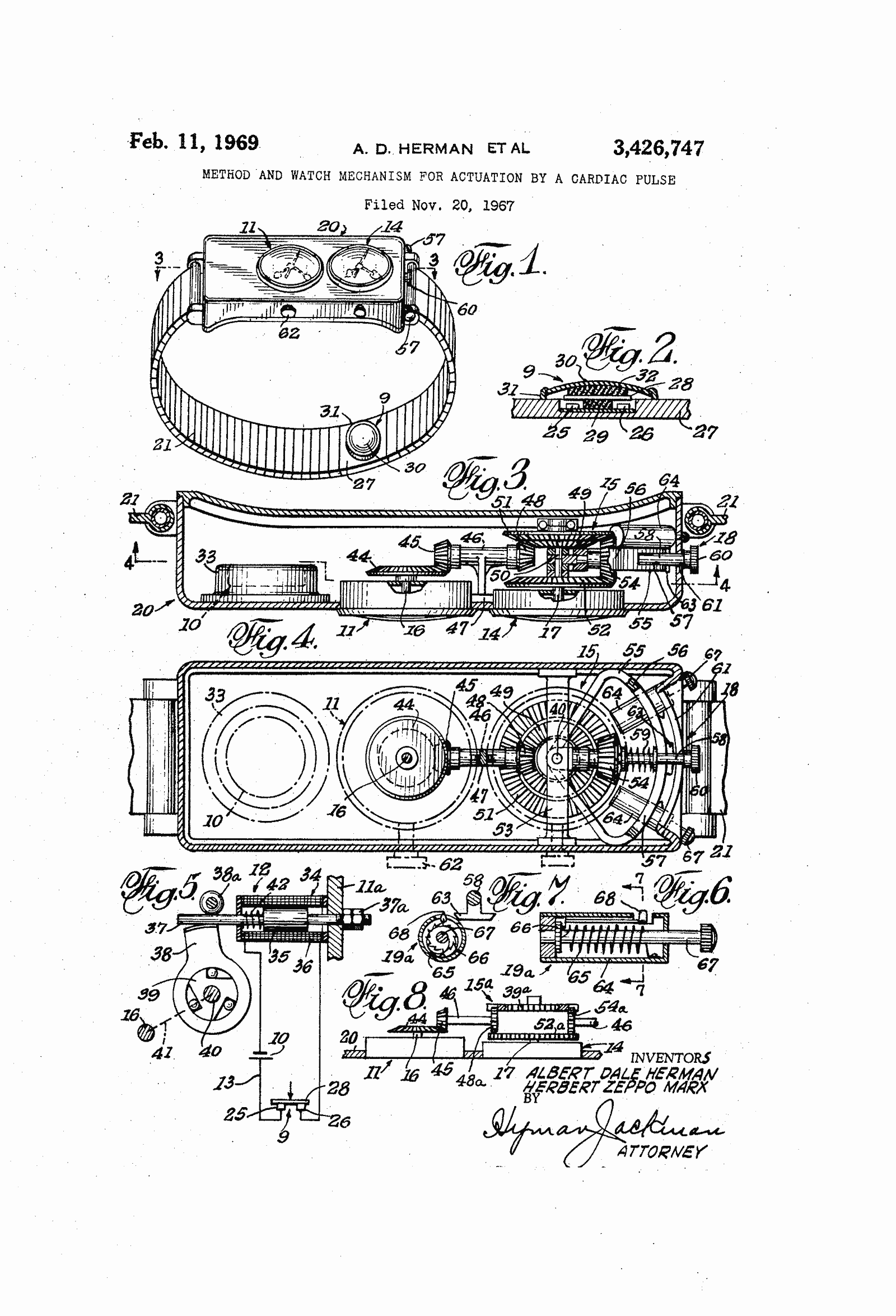
Earlier the same year Herman and Marx received a related patent, US3426747, on a watch driven by the pulse itself. It ran faster or slower as the heart did, and comparing it with an ordinary watch running at a steady rate showed the wearer how far their heart had drifted from normal. Its drawing is reproduced below the first.
Half a century early
Neither device made Zeppo a household name in medicine, and he also patented a therapeutic pad for delivering moist heat to a patient. He died in 1979.
But the idea is now on millions of wrists. A wearable that watches the heart and alerts the wearer to an abnormal rhythm is a standard feature of today's smartwatches. In 1969 the Marx Brother nobody remembers had already patented one, with a motor, a magnet and a hairspring.
See the original
The full text and figures of US3473526 are on Google Patents, and the earlier pulse-driven watch, US3426747, is here.
Related stories

A Rochester Woman Patented a Device for Pressing Dimples Into Your Cheeks
In 1923 Evangeline Isabella Gilbert applied for a patent on a spring-wire frame that hooked over the ears and pressed two small knobs into the cheeks, where dimples were wanted. It was granted in 1927, and the newspapers had fun with it for years.
Read the story →
Chicken Eyeglasses Were Patented in 1903, and Farmers Really Bought Them
Hens peck each other, sometimes to death. In 1903 Andrew Jackson Jr. of Munich, Tennessee, patented a tiny pair of spectacles for chickens. Later versions came with rose-colored lenses, on the theory that a hen who cannot see blood will not go after it.
Read the story →
In 1896 a Man From Spokane Patented a Hat That Tipped Itself When You Bowed
Raising your hat to a lady was basic manners in the 1890s, and it took a free hand. James C. Boyle's clockwork saluting device lifted the hat, spun it and put it back down every time the wearer nodded. He also suggested it would make a fine advertisement.
Read the story →
The Coffin Torpedo Was Patented to Shoot Grave Robbers
In 1878, as medical schools bought stolen bodies and a president's son turned up in a medical college, Philip Clover of Columbus, Ohio, patented a spring-loaded gun that went inside a coffin and fired if anyone tried to take the body.
Read the story →