In 1896 a Man From Spokane Patented a Hat That Tipped Itself When You Bowed
Raising your hat to a lady was basic manners in the 1890s, and it took a free hand. James C. Boyle's clockwork saluting device lifted the hat, spun it and put it back down every time the wearer nodded. He also suggested it would make a fine advertisement.

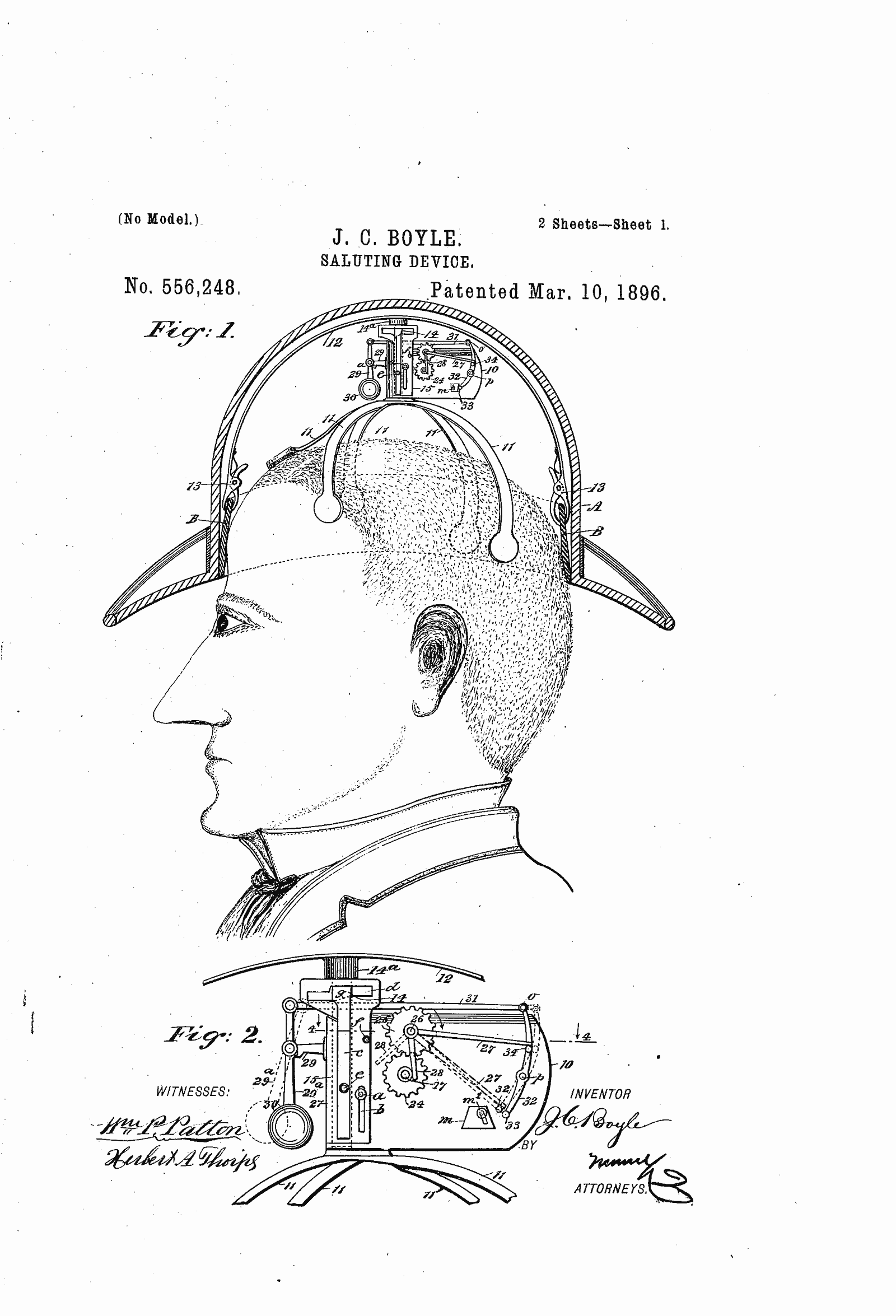
US556248 was filed on September 18, 1895, and granted on March 10, 1896, to James C. Boyle of Spokane, Washington, who assigned half of it to John Neill of the same city. The title is "Saluting Device."
Its purpose, in the patent's words, is "automatically effecting polite salutations by the elevation and rotation of the hat on the head of the saluting party when said person bows to the person or persons saluted," and all of it is done "without the use of the hands in any manner."
The problem
A gentleman of the period raised his hat to greet a woman, or anyone he wished to honor. It was a small, constant duty, and it needed a free hand. Anyone carrying parcels, an umbrella or a small child had a social problem.
The machine in the hat
Boyle's answer fits entirely inside the hat, hidden by it. A case holding the mechanism is attached to the wearer's head by curved spring fingers that gently clasp the skull. A coiled spring, wound in advance like a clock, supplies the power. A curved bow-piece clips onto the hat itself.
The trigger is the bow. When the wearer nods, a weighted block swings and releases the mechanism. The device lifts the hat, rotates it completely, and sets it back down correctly on the head every time the wearer bows and stands up straight again. A small check-block can be set to stop it working, for times when you would rather not salute anyone.
The second use
Boyle had a commercial afterthought, and it may be the most sensible line in the patent. The device, he wrote, "is also available as a unique and attractive advertising medium." Put a sign or placard on the hat, walk down a crowded street, and the novelty of a hat that moves by itself will draw every eye to it.
What became of it
There is no sign that anyone bought one. Hat-tipping faded in the twentieth century, along with the hats themselves, and the saluting device became a favorite of collections of strange patents.
It is easy to laugh at, and still oddly reasonable. Boyle saw a real, everyday inconvenience, worked out a mechanism that could actually do the job, and spotted the marketing angle as well. The only thing he misjudged was whether anyone wanted clockwork strapped to their head.
See the original
The full text and figures of US556248 are on Google Patents.
Related stories

A Rochester Woman Patented a Device for Pressing Dimples Into Your Cheeks
In 1923 Evangeline Isabella Gilbert applied for a patent on a spring-wire frame that hooked over the ears and pressed two small knobs into the cheeks, where dimples were wanted. It was granted in 1927, and the newspapers had fun with it for years.
Read the story →
Chicken Eyeglasses Were Patented in 1903, and Farmers Really Bought Them
Hens peck each other, sometimes to death. In 1903 Andrew Jackson Jr. of Munich, Tennessee, patented a tiny pair of spectacles for chickens. Later versions came with rose-colored lenses, on the theory that a hen who cannot see blood will not go after it.
Read the story →
The Coffin Torpedo Was Patented to Shoot Grave Robbers
In 1878, as medical schools bought stolen bodies and a president's son turned up in a medical college, Philip Clover of Columbus, Ohio, patented a spring-loaded gun that went inside a coffin and fired if anyone tried to take the body.
Read the story →
In Case You Were Buried Alive, This 1868 Coffin Came With a Ladder and a Bell
Nineteenth-century Americans were genuinely afraid of being buried alive. Franz Vester of Newark answered with a coffin topped by a tube to the surface, a ladder to climb it, and a bell cord placed in the hand of the deceased, just in case.
Read the story →