A Rochester Woman Patented a Device for Pressing Dimples Into Your Cheeks
In 1923 Evangeline Isabella Gilbert applied for a patent on a spring-wire frame that hooked over the ears and pressed two small knobs into the cheeks, where dimples were wanted. It was granted in 1927, and the newspapers had fun with it for years.

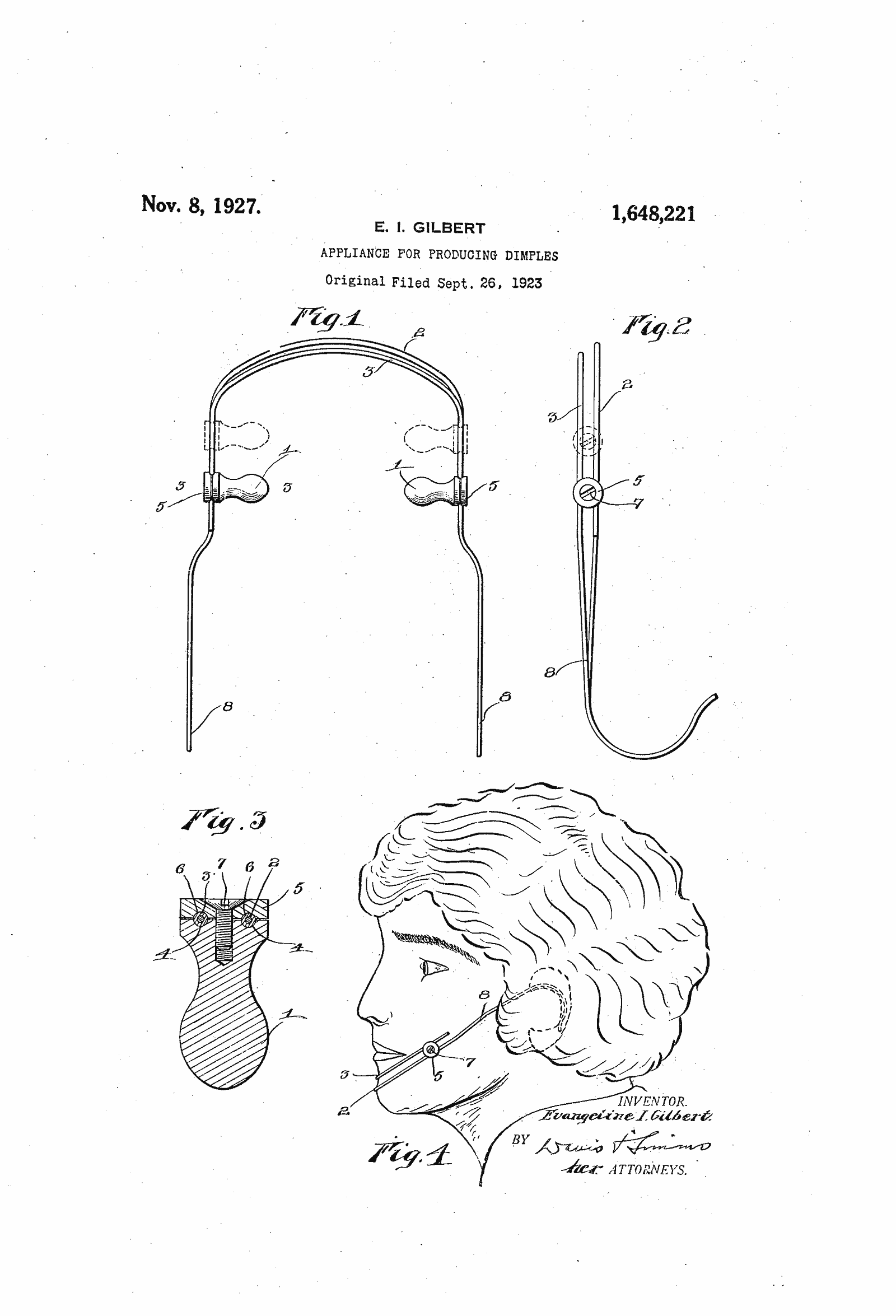
US1648221 was filed on September 26, 1923, and granted on November 8, 1927, to Evangeline I. Gilbert. The title is "Appliance for Producing Dimples." The press, which called her Isabella Gilbert of Rochester, New York, called it the dimple machine.
How to make a dimple
The appliance is simple. Two bows of resilient wire, covered in celluloid, are held a little apart. Mounted between them are two "dimple producing devices," small pieces that press into the cheeks. Each one can be loosened and slid along the bows, so the device "may be readily adjusted to fit the faces of different individuals, in order that dimples may be produced in the cheeks at the desired places." The ends of the bows form temples, like those of spectacles, that pass over the ears and hold the whole thing on.
The instructions follow from that. First, decide where you want your dimples. Then set the pressing devices to those points, put the appliance on, and let it work.
Why anyone wanted dimples
Dimples were fashionable, then as now. A real cheek dimple usually comes from a small variation in one of the facial muscles, which is why some people have them and most do not. Gilbert's appliance offered the rest of the population a way to try.
The patent took four years to come through. The application was renewed in 1926, and the grant followed in 1927. In 1936 she was in the newspapers again with an improved version, and a magazine ran the story under the headline that a woman had invented a dimple machine.
Did it work?
The patent makes no promises about results, and there is no good evidence that pressing on a cheek creates a lasting dimple. The device belongs to a crowded corner of the patent record: beauty appliances of the 1920s and 1930s that promised to reshape noses, lift chins and set waves in hair, some of them harmless and some of them not.
Gilbert's at least was gentle, and it was a woman's own idea for a market that women were building, the beauty business. The dimples, as far as anyone knows, did not come with it.
See the original
The full text and figures of US1648221 are on Google Patents.
Related stories

Chicken Eyeglasses Were Patented in 1903, and Farmers Really Bought Them
Hens peck each other, sometimes to death. In 1903 Andrew Jackson Jr. of Munich, Tennessee, patented a tiny pair of spectacles for chickens. Later versions came with rose-colored lenses, on the theory that a hen who cannot see blood will not go after it.
Read the story →
In 1896 a Man From Spokane Patented a Hat That Tipped Itself When You Bowed
Raising your hat to a lady was basic manners in the 1890s, and it took a free hand. James C. Boyle's clockwork saluting device lifted the hat, spun it and put it back down every time the wearer nodded. He also suggested it would make a fine advertisement.
Read the story →
The Coffin Torpedo Was Patented to Shoot Grave Robbers
In 1878, as medical schools bought stolen bodies and a president's son turned up in a medical college, Philip Clover of Columbus, Ohio, patented a spring-loaded gun that went inside a coffin and fired if anyone tried to take the body.
Read the story →
In Case You Were Buried Alive, This 1868 Coffin Came With a Ladder and a Bell
Nineteenth-century Americans were genuinely afraid of being buried alive. Franz Vester of Newark answered with a coffin topped by a tube to the surface, a ladder to climb it, and a bell cord placed in the hand of the deceased, just in case.
Read the story →