The Coffin Torpedo Was Patented to Shoot Grave Robbers
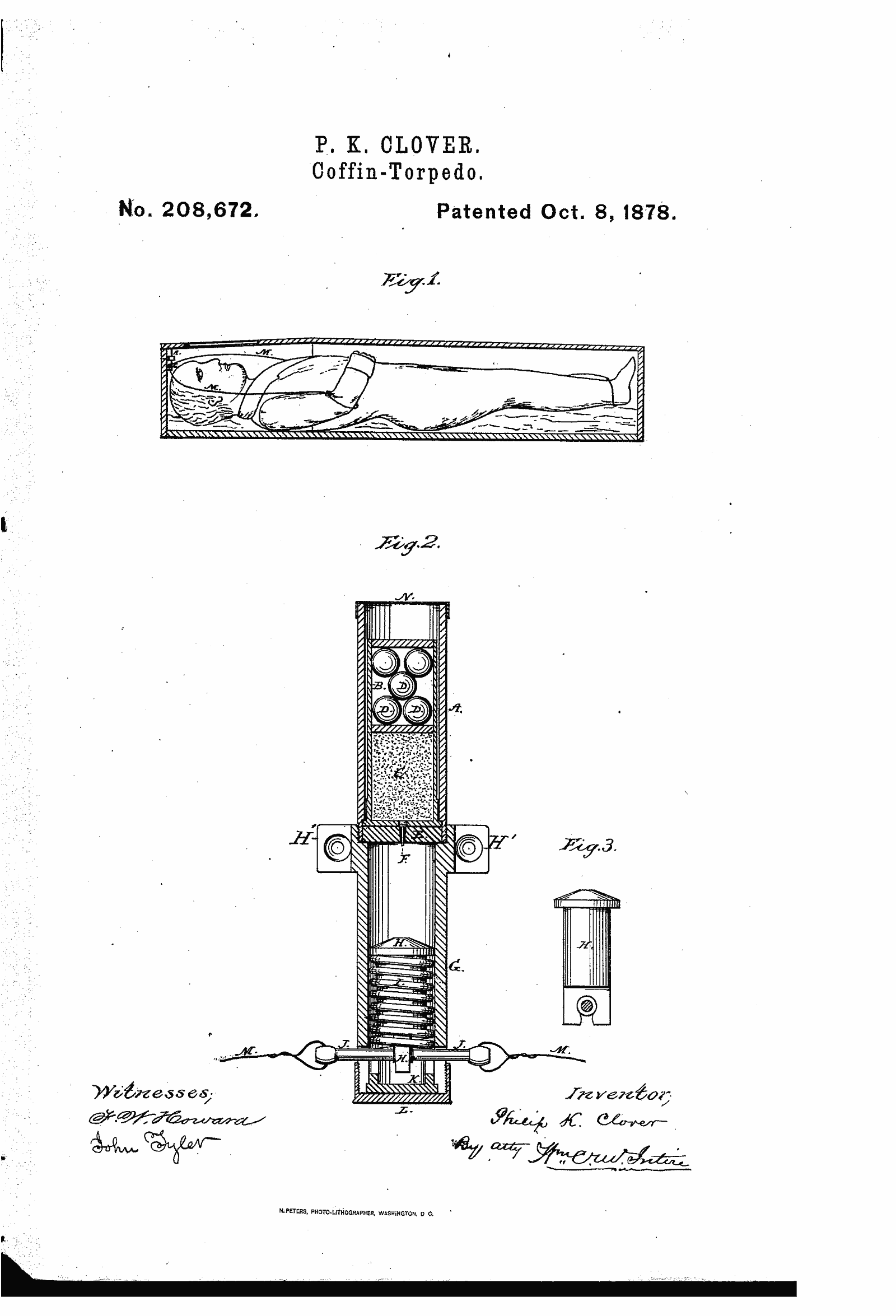
In 1878, as medical schools bought stolen bodies and a president's son turned up in a medical college, Philip Clover of Columbus, Ohio, patented a spring-loaded gun that went inside a coffin and fired if anyone tried to take the body.

US208672 was filed on June 29, 1878, and granted on October 8, 1878, to Philip K. Clover of Columbus, Ohio. The title is "Improvement in Coffin-Torpedoes." That the title begins with "improvement" tells you something about the times.
The patent states its purpose with unusual frankness. It is meant to "prevent the unauthorized resurrection of dead bodies."
Why anyone needed one
In nineteenth-century America, medical schools needed bodies to teach anatomy, and the law supplied very few. Grave robbers filled the gap, digging up the recently buried and selling them to the schools.
The summer of 1878 made the problem impossible to ignore in Ohio. John Scott Harrison, the son of one president and the father of another, died that May and was buried with precautions: a brick vault, heavy stones in the grave, a watchman. A day after the funeral, his family went to the Medical College of Ohio in Cincinnati looking for the body of a neighbor that had been stolen. They found Harrison's instead, hanging from a rope in a chute. Clover filed his application about a month later.
How it works
Clover's torpedo is, in effect, a small gun. A tube holds a cartridge. A hammer, driven by a stiff spring, is held back by a trigger. The device is fixed to the coffin and connected to the body inside it, so that, as the patent puts it, any attempt to remove the body after burial "will cause the discharge of the cartridge" and the "injury or death of the desecrator of the grave."
He was not the only one to think of it. In 1881 Thomas Howell of Circleville, Ohio, patented a similar "grave torpedo." That same year Ohio passed an anatomy law that gave medical schools legal access to unclaimed bodies, removing much of the trade's market.
Did anyone use one?
It is not clear that any coffin torpedo was ever fired at a grave robber. Few records suggest they were made in any number, and burying a loaded gun among the dead carried obvious risks for the cemetery staff and the family, too.
The idea sits at the other end of the same anxiety that produced the safety coffin. Some people feared they would be buried too soon. Others feared they would not be allowed to stay buried at all.
See the original
The full text and figures of US208672 are on Google Patents.
Related stories

A Rochester Woman Patented a Device for Pressing Dimples Into Your Cheeks
In 1923 Evangeline Isabella Gilbert applied for a patent on a spring-wire frame that hooked over the ears and pressed two small knobs into the cheeks, where dimples were wanted. It was granted in 1927, and the newspapers had fun with it for years.
Read the story →
Chicken Eyeglasses Were Patented in 1903, and Farmers Really Bought Them
Hens peck each other, sometimes to death. In 1903 Andrew Jackson Jr. of Munich, Tennessee, patented a tiny pair of spectacles for chickens. Later versions came with rose-colored lenses, on the theory that a hen who cannot see blood will not go after it.
Read the story →
In 1896 a Man From Spokane Patented a Hat That Tipped Itself When You Bowed
Raising your hat to a lady was basic manners in the 1890s, and it took a free hand. James C. Boyle's clockwork saluting device lifted the hat, spun it and put it back down every time the wearer nodded. He also suggested it would make a fine advertisement.
Read the story →
In Case You Were Buried Alive, This 1868 Coffin Came With a Ladder and a Bell
Nineteenth-century Americans were genuinely afraid of being buried alive. Franz Vester of Newark answered with a coffin topped by a tube to the surface, a ladder to climb it, and a bell cord placed in the hand of the deceased, just in case.
Read the story →