In Case You Were Buried Alive, This 1868 Coffin Came With a Ladder and a Bell
Nineteenth-century Americans were genuinely afraid of being buried alive. Franz Vester of Newark answered with a coffin topped by a tube to the surface, a ladder to climb it, and a bell cord placed in the hand of the deceased, just in case.

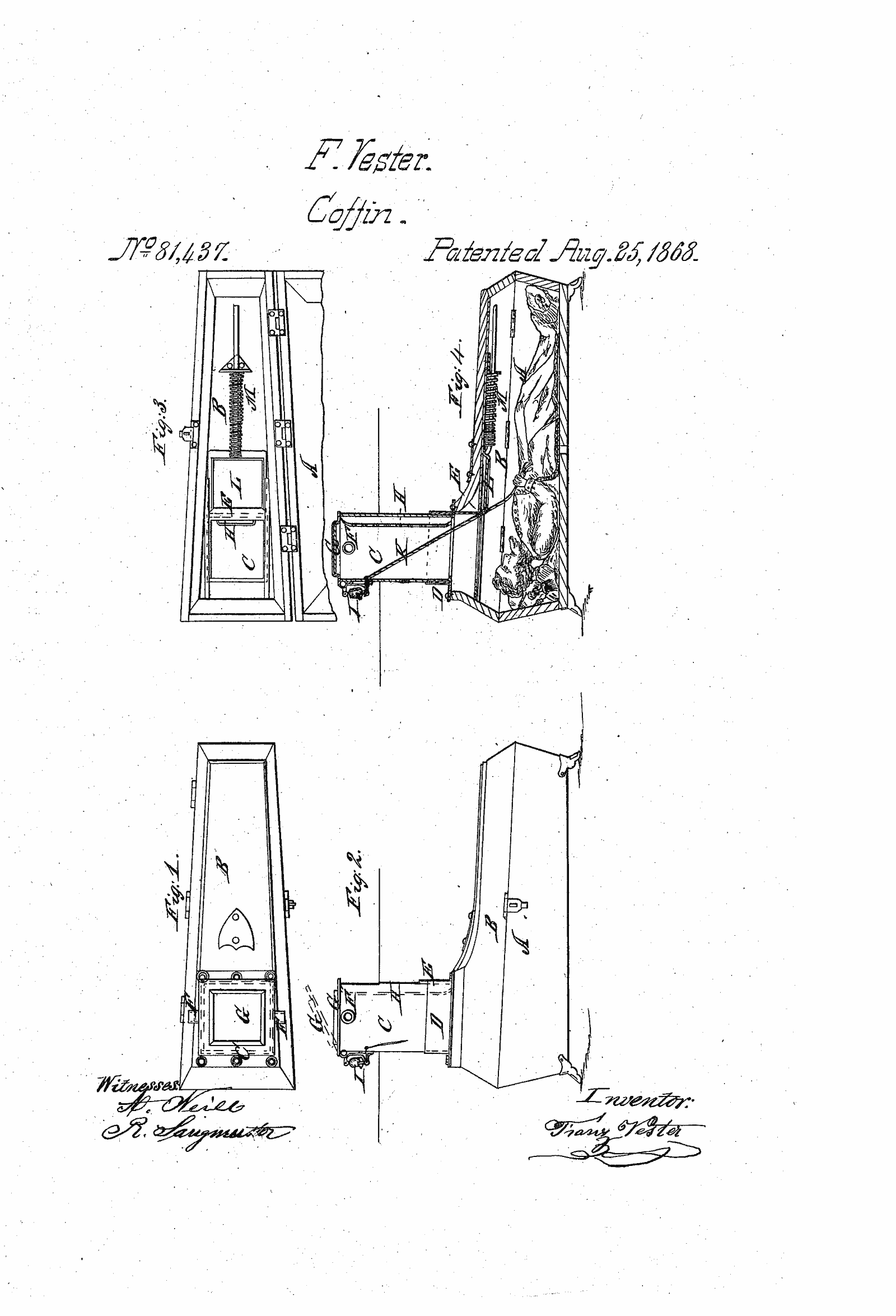
US81437 was granted on August 25, 1868, to Franz Vester of Newark, New Jersey. The title is "Improved Burial-Case." It is a coffin designed for a person who is not, in fact, dead.
A real fear
Being buried alive was a serious worry in the nineteenth century. Medicine could not always tell deep unconsciousness from death, and during the cholera epidemics, fear of contagion meant the dead and the dying were sometimes buried in a hurry. Stories of premature burial circulated in newspapers and books, and the fear had a name, taphophobia.
People acted on it. Before his death in 1792, Duke Ferdinand of Brunswick had his coffin fitted with a window, an air tube and a lock, and was buried with the keys. In 1822 a German doctor named Adolf Gutsmuth had himself buried alive in a safety coffin of his own design and stayed underground for several hours, eating a meal of soup, beer and sausages delivered down a pipe.
Vester's design
Vester's coffin has a square tube fixed to the lid directly over the face of the body. The tube rises through the grave to above the surface of the earth. Inside it is a ladder, by which, in the patent's words, the person in the coffin "may, on returning life, ascend to the surface of the earth."
For anyone too weak to climb, there is a bell. It hangs near the top of the tube, and its cord runs down and is placed in the hand of the person in the coffin.
The tube also let the living look down at the face below, which solved a real problem with earlier bell coffins. Bodies swell and shift as they decay, and a cord tied to a corpse could ring the bell with no one alive to ring it. With Vester's design, a watchman could look and see.
Once there was no more doubt, the tube could be drawn out of the ground. A sliding glass door, pushed by a spring, closed over the opening in the lid, and the tube was free to be used again.
Still being patented
Vester was one of many. Safety coffins with bells, flags, air pumps and windows were patented throughout the nineteenth century, and variations on the idea are still sold. In the same decade some families were worried about the opposite problem, which produced the coffin torpedo.
There is no record of anyone climbing out of a Vester coffin. That may be the best outcome a design like this can hope for.
See the original
The full text and figures of US81437 are on Google Patents.
Related stories

A Rochester Woman Patented a Device for Pressing Dimples Into Your Cheeks
In 1923 Evangeline Isabella Gilbert applied for a patent on a spring-wire frame that hooked over the ears and pressed two small knobs into the cheeks, where dimples were wanted. It was granted in 1927, and the newspapers had fun with it for years.
Read the story →
Chicken Eyeglasses Were Patented in 1903, and Farmers Really Bought Them
Hens peck each other, sometimes to death. In 1903 Andrew Jackson Jr. of Munich, Tennessee, patented a tiny pair of spectacles for chickens. Later versions came with rose-colored lenses, on the theory that a hen who cannot see blood will not go after it.
Read the story →
In 1896 a Man From Spokane Patented a Hat That Tipped Itself When You Bowed
Raising your hat to a lady was basic manners in the 1890s, and it took a free hand. James C. Boyle's clockwork saluting device lifted the hat, spun it and put it back down every time the wearer nodded. He also suggested it would make a fine advertisement.
Read the story →
The Coffin Torpedo Was Patented to Shoot Grave Robbers
In 1878, as medical schools bought stolen bodies and a president's son turned up in a medical college, Philip Clover of Columbus, Ohio, patented a spring-loaded gun that went inside a coffin and fired if anyone tried to take the body.
Read the story →