Chicken Eyeglasses Were Patented in 1903, and Farmers Really Bought Them
Hens peck each other, sometimes to death. In 1903 Andrew Jackson Jr. of Munich, Tennessee, patented a tiny pair of spectacles for chickens. Later versions came with rose-colored lenses, on the theory that a hen who cannot see blood will not go after it.

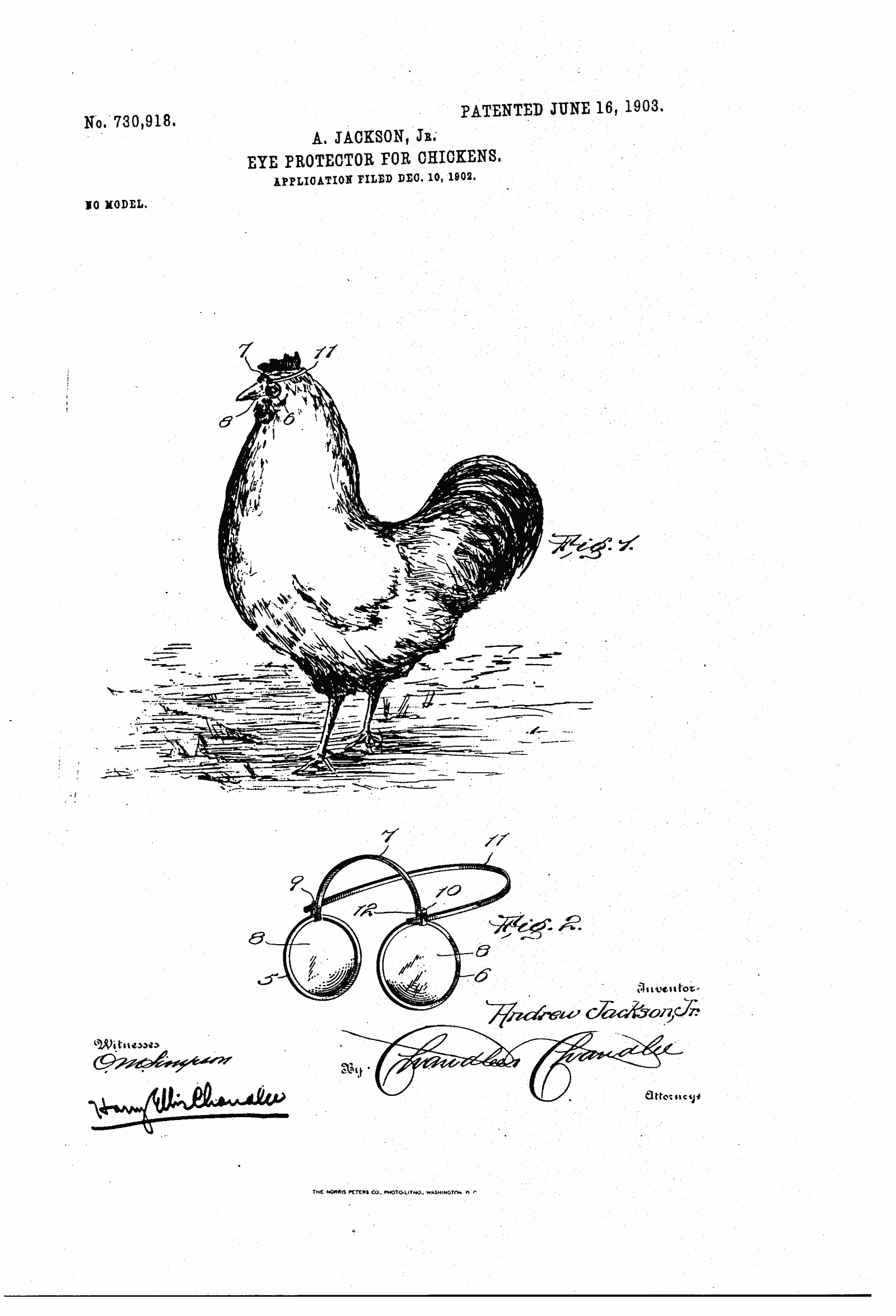
US730918 was filed on December 10, 1902, and granted on June 16, 1903, to Andrew Jackson Jr. of Munich, Tennessee. The title is "Eye-Protector for Chickens." It is exactly what it sounds like: eyeglasses for hens.
The problem in the henhouse
Chickens kept close together peck one another. It can start as pecking at feathers and end in serious injury, and once a bird is bleeding the others may turn on it. Poultry farmers had few good answers.
Jackson's patent describes protectors that would keep fowls safe "from other fowls that might attempt to peck them." Two frames, each a little larger than a chicken's eye, are sprung apart and fitted over the bird's head so that one frame encircles each eye, shielding it from pecks.
A real business
This was not a joke that died in the patent office. Chicken eyeglasses, sometimes called "specs" or "pick guards," were mass-produced and sold across the United States from early in the twentieth century, through feed stores and the Sears catalog, for a few cents each. Later designs were made of celluloid or aluminum and clipped over the beak. Some were held on by a pin through the nostrils, a method now illegal in some countries.
In 1939 the National Band & Tag Company, a major maker, added rose-colored lenses and called them "Anti-Pix." The idea was that a hen looking through red lenses would not see blood on her neighbors and so would not be drawn to attack them. The company's own Elmer Haas later said the rose color was there to please the farmers, not the birds, because, he believed, chickens are color blind. They are not. Birds see color well.
Chicken eyeglasses were still in use on some farms in the 1970s.
What replaced them
The modern industry largely solved the same problem a different way, by trimming the tip of the beak, which raises welfare concerns of its own. The little glasses survive mostly as collectors' items, and as one of the best-known strange patents of all.
The patent itself is short and sensible. It identifies a real problem, describes a light, cheap device that addresses it, and fits a hen with spectacles. It is not the invention that is absurd. It is how it looks on the chicken.
See the original
The full text and figures of US730918 are on Google Patents.
Related stories

A Rochester Woman Patented a Device for Pressing Dimples Into Your Cheeks
In 1923 Evangeline Isabella Gilbert applied for a patent on a spring-wire frame that hooked over the ears and pressed two small knobs into the cheeks, where dimples were wanted. It was granted in 1927, and the newspapers had fun with it for years.
Read the story →
In 1896 a Man From Spokane Patented a Hat That Tipped Itself When You Bowed
Raising your hat to a lady was basic manners in the 1890s, and it took a free hand. James C. Boyle's clockwork saluting device lifted the hat, spun it and put it back down every time the wearer nodded. He also suggested it would make a fine advertisement.
Read the story →
The Coffin Torpedo Was Patented to Shoot Grave Robbers
In 1878, as medical schools bought stolen bodies and a president's son turned up in a medical college, Philip Clover of Columbus, Ohio, patented a spring-loaded gun that went inside a coffin and fired if anyone tried to take the body.
Read the story →
In Case You Were Buried Alive, This 1868 Coffin Came With a Ladder and a Bell
Nineteenth-century Americans were genuinely afraid of being buried alive. Franz Vester of Newark answered with a coffin topped by a tube to the surface, a ladder to climb it, and a bell cord placed in the hand of the deceased, just in case.
Read the story →