They Patented the Barcode and Sold It for Fifteen Thousand Dollars
In 1949, two graduate students at Drexel filed a patent for a 'classifying apparatus' that used printed concentric circles to identify items at a checkout counter. The patent expired in 1969 — five years before the first barcode was ever scanned in a grocery store.
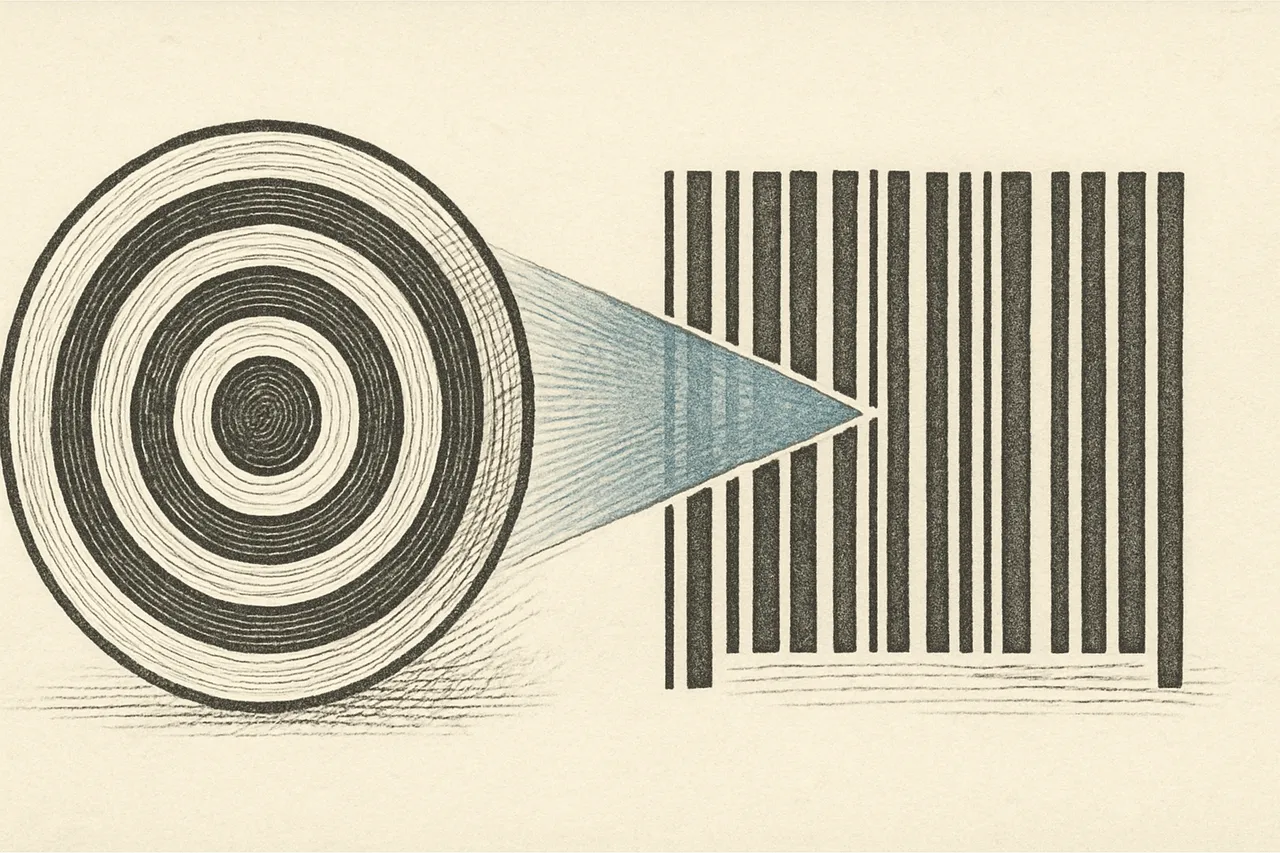
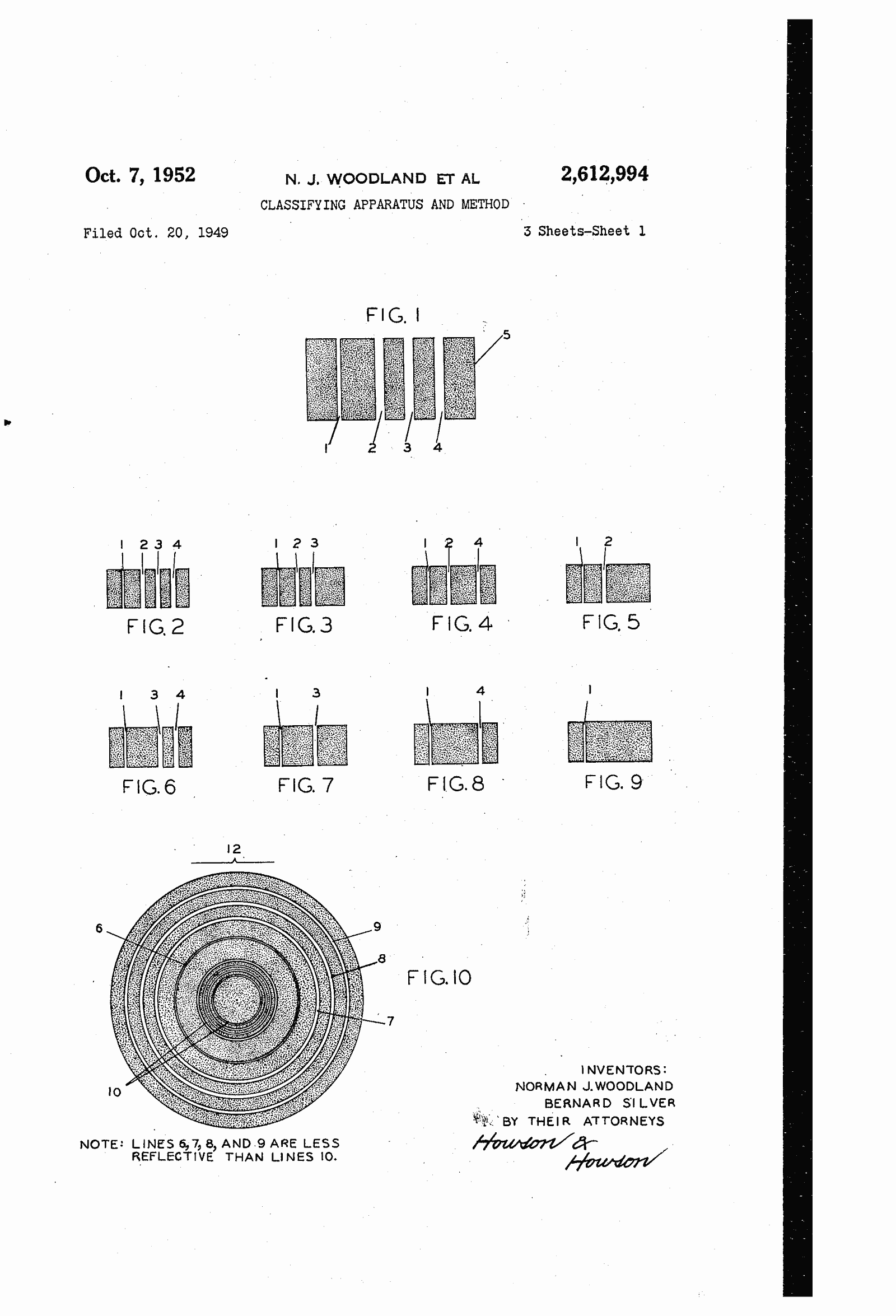
US2612994 was filed on October 20, 1949, by Bernard Silver and Norman Joseph Woodland, both graduate students at the Drexel Institute of Technology in Philadelphia. The title is "Classifying Apparatus and Method." The drawings show a series of concentric printed circles — a bullseye pattern — that could be scanned at any rotational angle by a light-sensing apparatus and decoded as a unique numerical identifier.
It was the barcode. Twenty-five years before there was any commercial use for one.
The origin story has been told often enough to have hardened into something close to canon. In late 1948, Silver had overheard a conversation between a Drexel dean and the president of Food Fair, a Philadelphia supermarket chain, who had come to the institute hoping to commission research into automatic checkout. Manually keying product prices into mechanical registers, the executive complained, was the slowest and most error-prone part of grocery retail. Anyone who could automate it would change the industry.
The dean had declined the project as outside the institute's curriculum. Silver and Woodland, both graduate students at the time, picked it up themselves.
The bullseye
Woodland reportedly conceived the concentric-circle pattern in early 1949 while sitting on a beach in Miami, drawing Morse-code dots and dashes in the sand with his fingers and then sweeping them outward into circles to make them rotation-invariant. The bullseye worked: a light-sensing photocell sweeping across the pattern in any direction would produce a unique signal that encoded the product's identifier.
They built working prototypes using ultraviolet ink on cardboard. The prototypes worked well enough to demonstrate the concept and to support the patent application but nowhere near well enough for commercial deployment. The two essential pieces of infrastructure — a cheap, narrow-beam light source for the scanner, and cheap computing to look up product codes against a price database — would not exist for another twenty years.
Fifteen thousand dollars
The patent issued on October 7, 1952. Silver and Woodland tried to interest companies in licensing it. RCA, IBM, Philco, and various supermarket chains all looked at the technology. None bought. The state of the art in 1952 simply could not make the system work at a price that grocery stores would pay.
In 1962, Silver and Woodland sold the entire patent to Philco for $15,000. Philco resold to RCA shortly after. Woodland himself, by then working at IBM, had largely moved on. The patent expired on its scheduled term in 1969.
What they missed
Five years later, in June 1974, a clerk at a Marsh Supermarket in Troy, Ohio, scanned a ten-pack of Wrigley's Juicy Fruit gum across a laser scanner. It was the first commercial barcode scan in history. The barcode in question was not the Silver-Woodland bullseye — it was the linear, rectangular Universal Product Code (UPC) developed at IBM by a team that included, by then, Norman Woodland himself.
The patent on the UPC was held by IBM. Silver and Woodland received nothing from the commercial success of the technology they had founded. Silver had died in 1963, at age 38, in a house fire — twelve years before the Marsh Supermarket scan. Woodland lived on until 2012; he received the National Medal of Technology from President George H.W. Bush in 1992, and the National Inventors Hall of Fame inducted him posthumously the following year.
The pack of Wrigley's chewing gum, by the way, is in the Smithsonian.
See the original
The full text and figures of US2612994 are on Google Patents.
Related stories
The Escalator Was Patented in 1859. Nobody Built One for Thirty Years.
Nathan Ames patented 'revolving stairs' before the Civil War. He admitted he wasn't sure what would power them, never built one, and died four years later at thirty-nine. The moving staircase arrived a generation after he did.
Read the story →
Bell Called It His Greatest Invention. It Sent Speech on a Beam of Light — in 1880.
Alexander Graham Bell thought the photophone, not the telephone, was his finest work. It transmitted the human voice on a beam of sunlight, with no wires at all. It was also a century early: the world had no use for it until fiber optics arrived.
Read the story →
Edwin Armstrong Invented Static-Free Radio. Then the Industry He Threatened Destroyed Him.
FM radio was better than AM in every way — no static, higher fidelity, less power. That was exactly the problem. The company that dominated AM spent two decades in court to bury it, and the inventor spent his fortune fighting back before jumping from his apartment window.
Read the story →
The New York Times Mocked Goddard's Rocket. It Apologized 49 Years Later — Mid-Flight to the Moon.
Robert Goddard patented the fundamentals of the liquid-fuel rocket in 1914. When he suggested a rocket could reach the Moon, a newspaper editorial declared he lacked 'the knowledge ladled out daily in high schools.' The correction ran during Apollo 11.
Read the story →