The New York Times Mocked Goddard's Rocket. It Apologized 49 Years Later — Mid-Flight to the Moon.
Robert Goddard patented the fundamentals of the liquid-fuel rocket in 1914. When he suggested a rocket could reach the Moon, a newspaper editorial declared he lacked 'the knowledge ladled out daily in high schools.' The correction ran during Apollo 11.
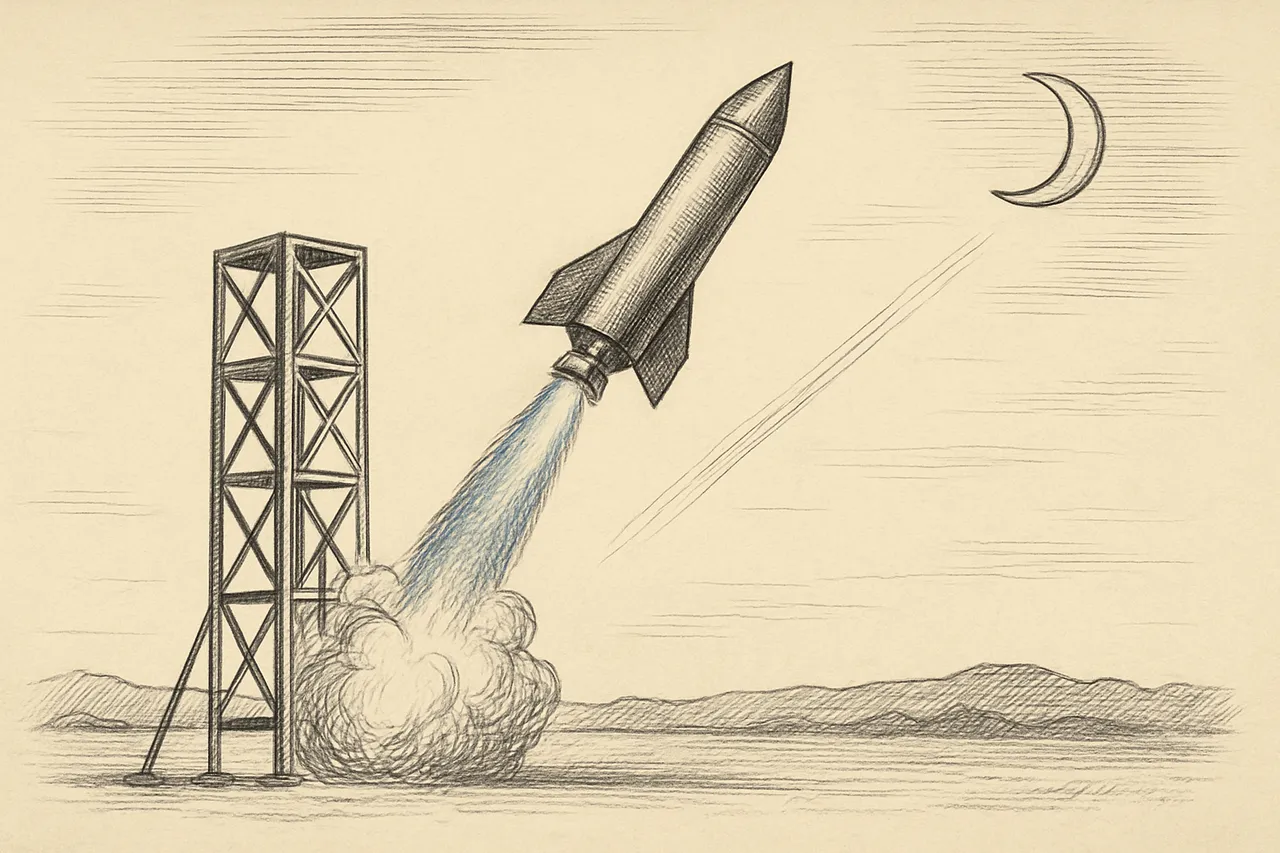
US1103503 was filed on October 1, 1913, and granted on July 7, 1914, to Robert H. Goddard. The title is "Rocket Apparatus." Together with its companion patent, US1102653, granted the same day, it lays out the foundational architecture of the modern rocket: a combustion chamber, a nozzle, a mechanism for feeding propellant, and — most importantly — the use of liquid fuels and the principle of multiple stages.
Goddard was a physics professor at Clark University in Massachusetts. He had been obsessed with spaceflight since, by his own account, climbing a cherry tree as a boy and imagining a device that could ascend to Mars. Unlike almost everyone else who had that kind of daydream, he did the mathematics, and the mathematics told him it could actually be done — that a rocket, unlike an airplane or a balloon, does not need air to push against and could therefore operate in the vacuum of space.
The mockery
In 1920, the Smithsonian published a modest monograph by Goddard, A Method of Reaching Extreme Altitudes, summarizing his research. Most of it concerned the upper atmosphere. But in one passage, Goddard noted that a sufficiently powerful rocket could, in principle, reach the Moon, and that you could prove it had arrived by having it detonate a load of flash powder visible through a telescope.
The press seized on the Moon passage. On January 13, 1920, The New York Times ran an unsigned editorial ridiculing him. It argued that a rocket could not possibly work in the vacuum of space because it would have nothing to push against — that a rocket needs air behind it to react against, "to say that would be absurd." The editorial concluded that Professor Goddard, "with his 'chair' in Clark College and the countenancing of the Smithsonian Institution," seemed only to lack "the knowledge ladled out daily in high schools."
The editorial was, of course, completely wrong. A rocket works by Newton's third law — it pushes against its own expelled exhaust, not against the surrounding air — and works better in a vacuum, not worse. The high-school physics the Times invoked was exactly the physics that proved Goddard right and the editorial writer wrong.
The vindication
Goddard, stung and intensely private, largely withdrew from public engagement and continued his work in relative isolation, launching the world's first liquid-fueled rocket from his aunt's farm in Auburn, Massachusetts, in 1926. It rose 41 feet. He died in 1945, holding 214 patents, having never received in his lifetime the recognition or funding his work deserved — much of which went instead to the German rocket program that had studied his published research closely.
On July 17, 1969 — as Apollo 11 was three days into its flight to the Moon, carried by a Saturn V rocket built on every principle Goddard had patented — The New York Times published a short correction. It quoted its 1920 editorial, noted that "it is now definitely established that a rocket can function in a vacuum as well as in an atmosphere," and stated: "The Times regrets the error."
See the original
The full text and figures of US1103503 are on patents.us.
Related stories
The Escalator Was Patented in 1859. Nobody Built One for Thirty Years.
Nathan Ames patented 'revolving stairs' before the Civil War. He admitted he wasn't sure what would power them, never built one, and died four years later at thirty-nine. The moving staircase arrived a generation after he did.
Read the story →
Bell Called It His Greatest Invention. It Sent Speech on a Beam of Light — in 1880.
Alexander Graham Bell thought the photophone, not the telephone, was his finest work. It transmitted the human voice on a beam of sunlight, with no wires at all. It was also a century early: the world had no use for it until fiber optics arrived.
Read the story →
Edwin Armstrong Invented Static-Free Radio. Then the Industry He Threatened Destroyed Him.
FM radio was better than AM in every way — no static, higher fidelity, less power. That was exactly the problem. The company that dominated AM spent two decades in court to bury it, and the inventor spent his fortune fighting back before jumping from his apartment window.
Read the story →
Chester Carlson Invented the Photocopier. Twenty Companies Said No.
A patent attorney tired of copying documents by hand invented dry photocopying in his kitchen in 1938. IBM, Kodak, GE, RCA, and the US Navy all turned it down. The company that finally said yes became Xerox.
Read the story →