Tesla Patented a Way to Beam Power Through the Earth. Then the Money Ran Out.
Nikola Tesla believed he could transmit electricity wirelessly to anywhere on Earth, using the planet itself as a conductor. He built a 187-foot tower on Long Island to prove it. The patent was granted the same year the tower's funding collapsed for good.
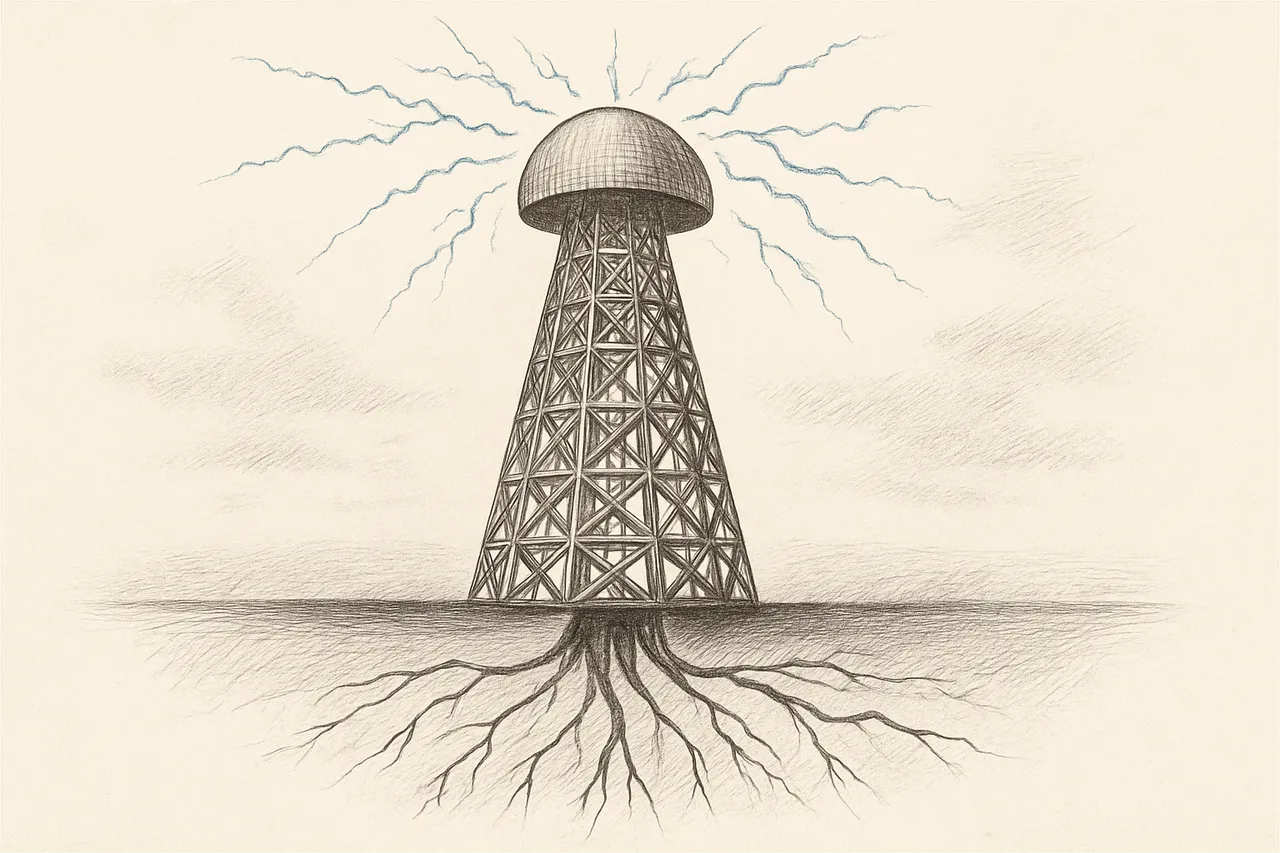
US1119732 was filed on January 18, 1902, and — after one of the longest pendencies in the patent record — finally granted on December 1, 1914. The title is "Apparatus for Transmitting Electrical Energy." The apparatus is Tesla's system for wireless power transmission: the idea that electrical energy could be sent, without wires, over any distance, using the Earth itself and its upper atmosphere as the conducting medium.
By 1900, Tesla was already famous. His alternating-current system had won the "War of the Currents" against Edison's direct current and was electrifying the country. But Tesla's ambitions had moved on to something far larger than power distribution by wire. He believed he could dispense with the wires entirely — that a properly designed transmitter could pump electrical energy into the ground, set up resonant standing waves in the Earth, and allow receivers anywhere on the planet to draw that energy out of the ground beneath them, like tapping a global reservoir.
Wardenclyffe
To prove it, Tesla needed capital, and he got it from J.P. Morgan, the most powerful financier in America. With Morgan's initial investment of $150,000, Tesla began building Wardenclyffe: a laboratory and a 187-foot transmitting tower on Long Island, topped with a great mushroom-shaped copper dome, with an iron root system driving hundreds of feet into the earth to make electrical contact with the planet.
The trouble was partly technical and partly a matter of what Tesla had actually promised. Morgan had understood he was funding wireless communication — a competitor to Marconi's radio, which was rapidly proving that transatlantic wireless telegraphy worked. When it became clear that Tesla's real goal was wireless power — free energy transmitted to anyone, anywhere, which is a difficult thing to build a business model around, since you cannot easily meter what you cannot contain — Morgan's enthusiasm cooled. Famously, Morgan is said to have asked the essential capitalist's question: if anyone can draw the power, where do we put the meter?
Morgan declined to provide further funding. Other investors, seeing Morgan withdraw and watching Marconi win the wireless-communication race, stayed away. Tesla poured his own dwindling money into the project for years, but the tower was never completed to his specifications and never demonstrated the global power transmission he was certain it could achieve.
The collapse
By 1906, work at Wardenclyffe had effectively stopped. Tesla lost the property to creditors. The great tower stood unused and was finally demolished in 1917 — its materials sold for scrap to help pay Tesla's debts — three years after the patent describing its principle was granted.
Whether Tesla's system would ever have worked remains genuinely disputed. Some of the physics he described (resonant coupling, the electrical properties of the Earth) is sound and underlies real modern technology; the specific claim of efficient, long-distance, planet-wide wireless power transmission is regarded by most engineers as impossible at the scale and efficiency Tesla imagined. What is not disputed is that he believed it completely, staked his fortune and reputation on it, and died in 1943 in a New York hotel room, alone and in debt, still convinced the world had simply not yet been willing to build what he had shown them.
Wireless power transmission is now real — it charges your phone and your toothbrush — but only across the distance of a few millimeters, using the resonant-coupling principles Tesla pioneered, and nothing remotely like the global grid he described in US1119732.
See the original
The full text and figures of US1119732 are on patents.us.
Related stories
The Escalator Was Patented in 1859. Nobody Built One for Thirty Years.
Nathan Ames patented 'revolving stairs' before the Civil War. He admitted he wasn't sure what would power them, never built one, and died four years later at thirty-nine. The moving staircase arrived a generation after he did.
Read the story →
Bell Called It His Greatest Invention. It Sent Speech on a Beam of Light — in 1880.
Alexander Graham Bell thought the photophone, not the telephone, was his finest work. It transmitted the human voice on a beam of sunlight, with no wires at all. It was also a century early: the world had no use for it until fiber optics arrived.
Read the story →
Edwin Armstrong Invented Static-Free Radio. Then the Industry He Threatened Destroyed Him.
FM radio was better than AM in every way — no static, higher fidelity, less power. That was exactly the problem. The company that dominated AM spent two decades in court to bury it, and the inventor spent his fortune fighting back before jumping from his apartment window.
Read the story →
The New York Times Mocked Goddard's Rocket. It Apologized 49 Years Later — Mid-Flight to the Moon.
Robert Goddard patented the fundamentals of the liquid-fuel rocket in 1914. When he suggested a rocket could reach the Moon, a newspaper editorial declared he lacked 'the knowledge ladled out daily in high schools.' The correction ran during Apollo 11.
Read the story →