Philo Farnsworth Sketched Television in a Potato Field at Fourteen
A Mormon farm boy in Idaho realized in 1921 that an electron beam could scan an image one row at a time, just like the rows under his plow. Six years later, at age twenty, he filed the patent. The fight to keep it from RCA consumed the rest of his life.
In the summer of 1921, on a farm outside Rigby, Idaho, a fourteen-year-old boy named Philo T. Farnsworth was disking a potato field. He had been reading recent issues of Popular Science and Radio News, both of which had been speculating about how "television" — a word that did not yet refer to anything real — might eventually work. The leading proposed approach involved spinning mechanical disks with holes punched in spirals, which would chop a scene into a sequence of light pulses that a receiver could reassemble. It was crude. It would never produce a watchable picture.
Looking down at the parallel rows the disk plow was cutting in the field, Farnsworth had the idea that defined the next century of broadcasting. You don't need spinning disks. You need an electron beam in a vacuum tube, deflected by magnets, scanning an image one row at a time, exactly like the rows of furrows in the field. Same principle as a plow, but at sixty rows per second, and using electrons instead of steel.
He drew the diagram on a chalkboard for his high school chemistry teacher, Justin Tolman, the next school year. Tolman kept the drawing.
The patent
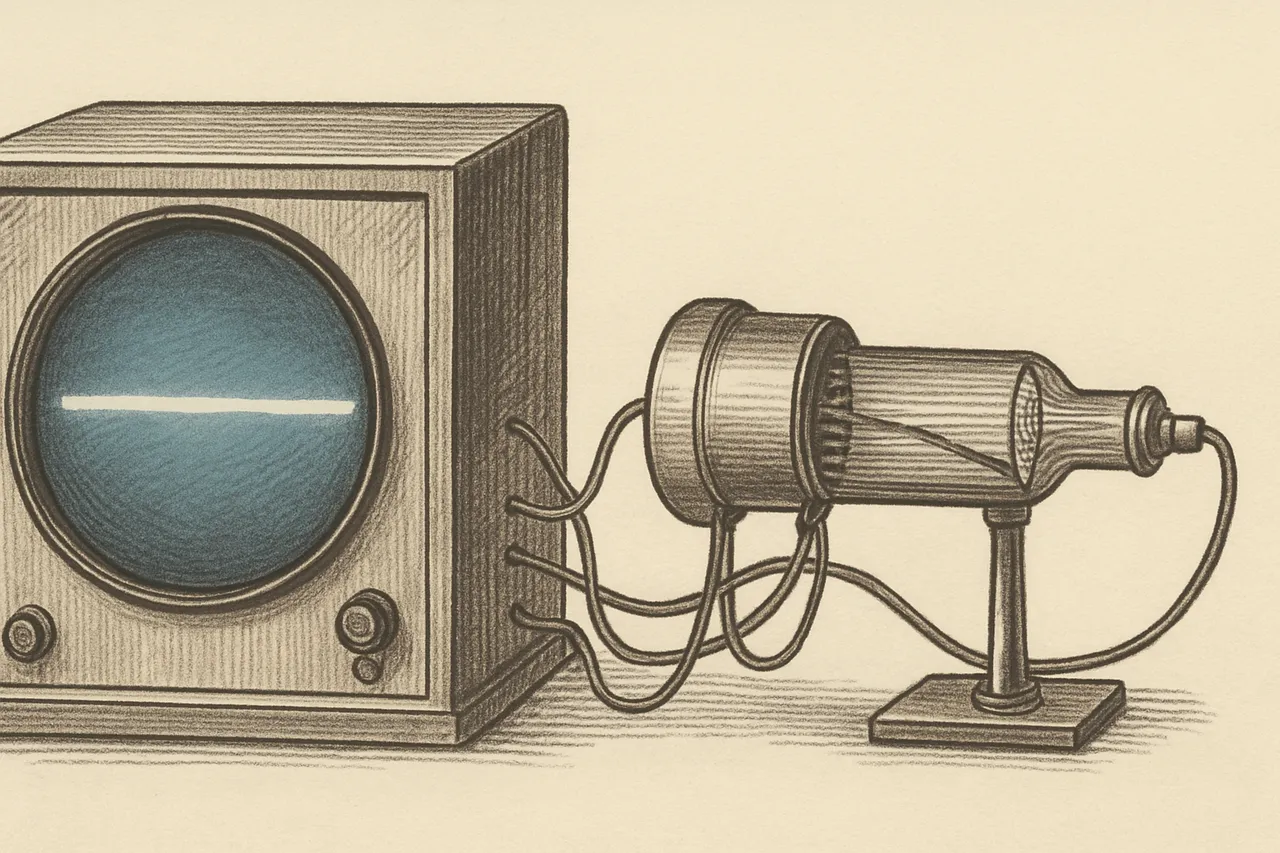
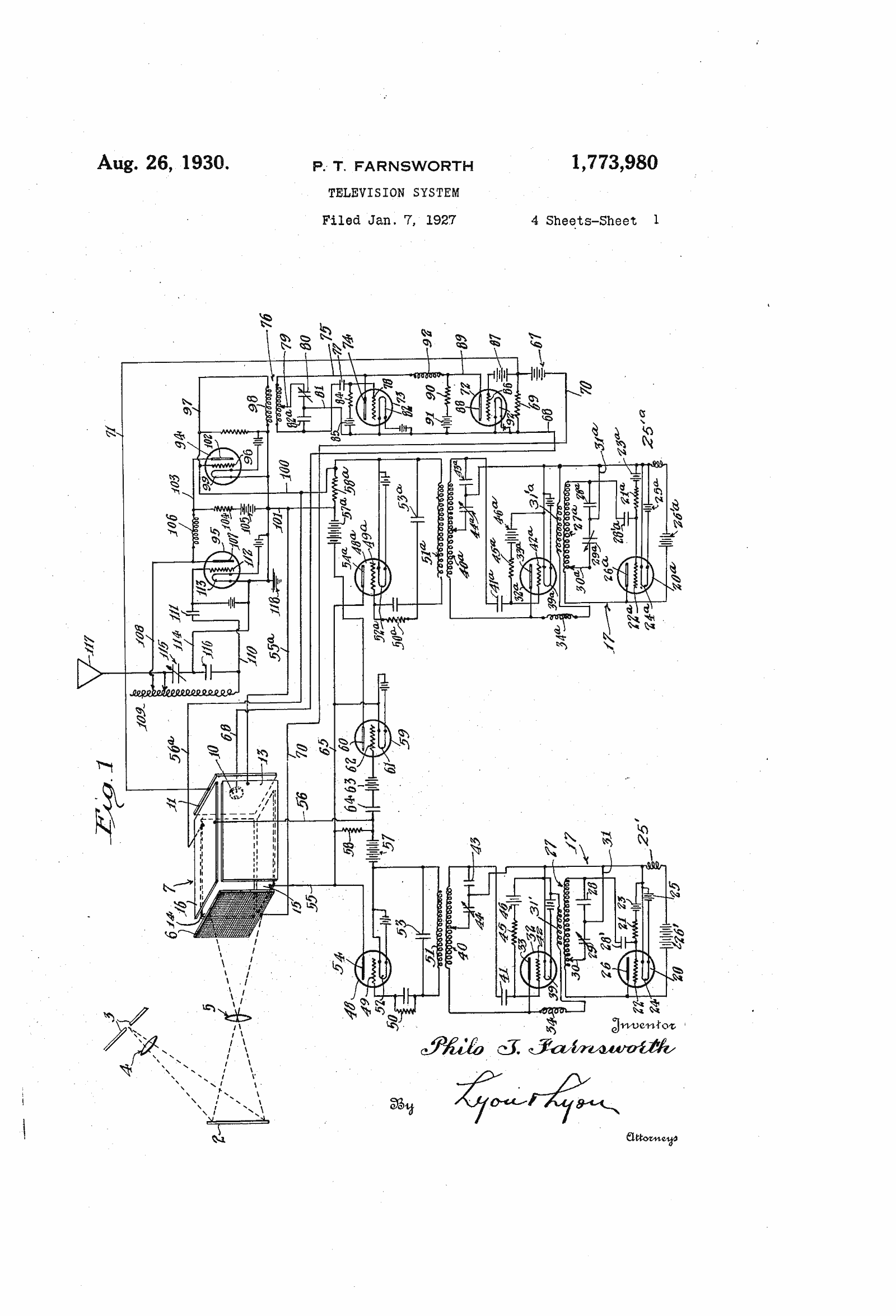
Farnsworth filed for US1773980 — "Television System" — on January 7, 1927. He was twenty years old. He had a small lab in San Francisco, funded by two California investors who had taken a risk on a Mormon farm boy with no formal engineering training. On September 7, 1927, in that lab, he transmitted the first all-electronic television image: a single line, displayed on a receiving tube. Six months later, he transmitted the dollar sign, projected from a glass slide. The image was unmistakable. Working television existed.
The patent issued on August 26, 1930.
The RCA fight
David Sarnoff, the head of the Radio Corporation of America, had been planning his own television empire for years. RCA's own engineering team, led by Vladimir Zworykin, was working on a competing system. In 1930, Sarnoff sent Zworykin to "tour" Farnsworth's San Francisco lab. Farnsworth, naive about industrial espionage, gave the tour. Zworykin reportedly remarked, on seeing the working image dissector, "this is a beautiful instrument. I wish I had thought of it myself." He went back to RCA and filed competing patents.
The patent fight ran for four years. RCA was the most powerful company in American broadcasting. It had never, in its history, paid royalties to anyone — it was always the licensor, never the licensee. It claimed prior invention, claimed Farnsworth's design was obvious, claimed the patent was invalid.
The case turned on Justin Tolman's chalkboard. The chemistry teacher, by then in his sixties, took the stand at the Patent Office hearings and reproduced — from memory and from notes he had kept — the diagram his fourteen-year-old student had drawn in his class in 1922. The hearing examiner ruled for Farnsworth in 1934. RCA, for the first time in its corporate history, agreed to pay royalties.
What didn't happen
The royalty agreement was for a million dollars over ten years, plus per-unit licensing. By the time television manufacturing finally took off after World War II, Farnsworth's patent had expired (1947, seventeen-year term). The royalties he did receive were eaten up by years of legal fees. He spent his later career on fusion-reactor research. He drank heavily. He gave up television entirely.
In 1957, he appeared as the mystery guest on the CBS panel show I've Got a Secret. The panelists, all professional broadcasters, could not guess that the modest man in the chair had invented the medium they worked in. He was given $80 and a carton of Winston cigarettes for his appearance.
He died in 1971, more or less forgotten outside a small circle of broadcast historians. The full posthumous recognition began in the 1990s. There is now a statue of him in the US Capitol's National Statuary Hall, representing the State of Utah. Aaron Sorkin's play The Farnsworth Invention opened on Broadway in 2007. The chemistry teacher's testimony is now a standard case study in patent law.
See the original
The full text and figures of US1773980 are on Google Patents.
Related stories
The Escalator Was Patented in 1859. Nobody Built One for Thirty Years.
Nathan Ames patented 'revolving stairs' before the Civil War. He admitted he wasn't sure what would power them, never built one, and died four years later at thirty-nine. The moving staircase arrived a generation after he did.
Read the story →
Bell Called It His Greatest Invention. It Sent Speech on a Beam of Light — in 1880.
Alexander Graham Bell thought the photophone, not the telephone, was his finest work. It transmitted the human voice on a beam of sunlight, with no wires at all. It was also a century early: the world had no use for it until fiber optics arrived.
Read the story →
Edwin Armstrong Invented Static-Free Radio. Then the Industry He Threatened Destroyed Him.
FM radio was better than AM in every way — no static, higher fidelity, less power. That was exactly the problem. The company that dominated AM spent two decades in court to bury it, and the inventor spent his fortune fighting back before jumping from his apartment window.
Read the story →
The New York Times Mocked Goddard's Rocket. It Apologized 49 Years Later — Mid-Flight to the Moon.
Robert Goddard patented the fundamentals of the liquid-fuel rocket in 1914. When he suggested a rocket could reach the Moon, a newspaper editorial declared he lacked 'the knowledge ladled out daily in high schools.' The correction ran during Apollo 11.
Read the story →