Chester Carlson Invented the Photocopier. Twenty Companies Said No.
A patent attorney tired of copying documents by hand invented dry photocopying in his kitchen in 1938. IBM, Kodak, GE, RCA, and the US Navy all turned it down. The company that finally said yes became Xerox.
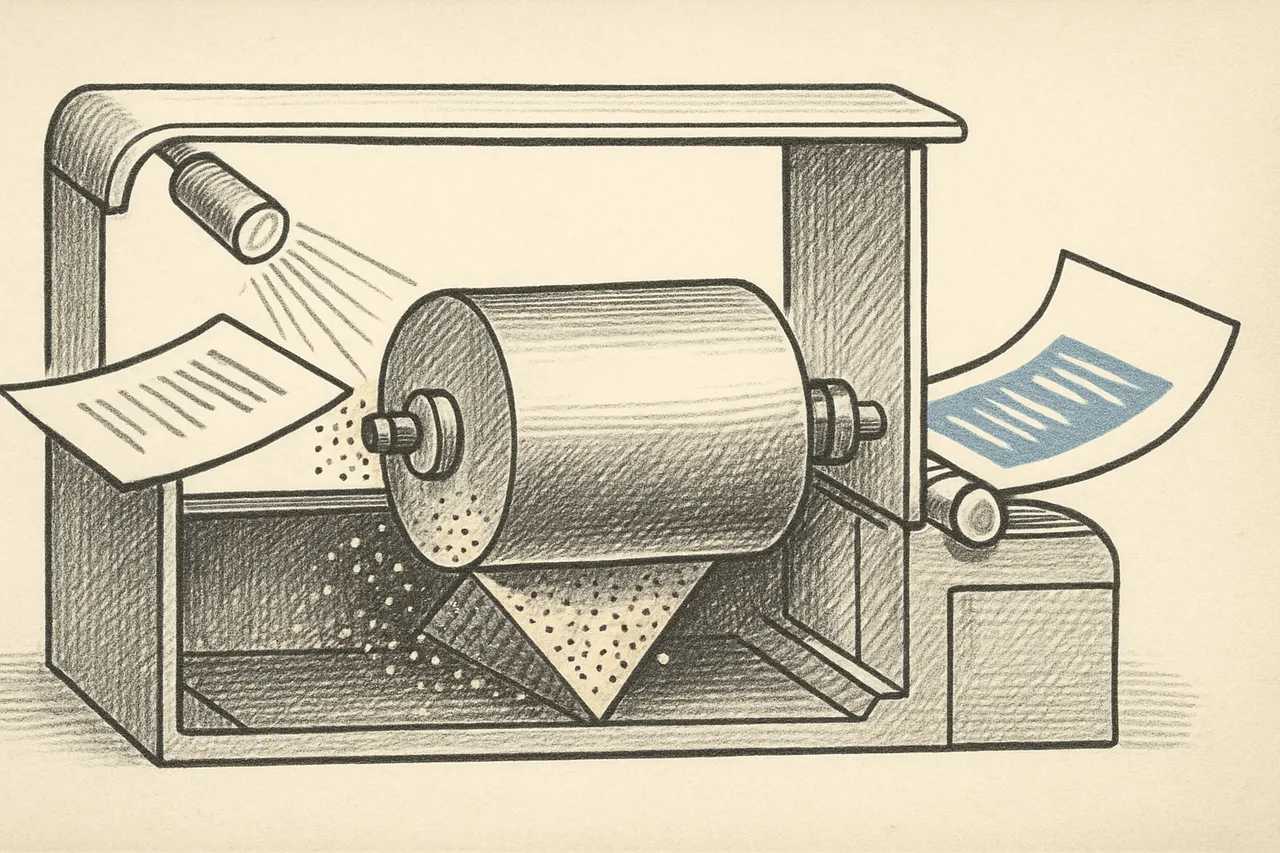
US2297691 was filed on April 4, 1939, and granted on October 6, 1942. The title is "Electrophotography." The inventor is Chester F. Carlson, a patent attorney in New York.
Carlson's day job was the problem. As a patent lawyer, he spent enormous amounts of time copying patent specifications and drawings — work that, in the 1930s, meant either re-typing documents by hand or sending them out for slow, expensive photostat reproduction. Carlson had arthritis, which made the hand-copying physically painful, and a chemistry background, which made him think the problem ought to be solvable. He began experimenting in his apartment, then in a rented room behind a beauty parlor in Astoria, Queens.
The first copy
The process he worked out, which he called electrophotography and later renamed xerography (from the Greek for "dry writing"), is genuinely strange the first time you encounter it. Coat a plate with a photoconductive material. Give it an electrostatic charge in the dark. Expose it to an image — the charge drains away everywhere light hits, and remains only in the dark areas corresponding to the text. Dust the plate with an oppositely-charged powder, which sticks only to the charged regions. Press paper against it, and transfer the powder. Apply heat to fuse the powder permanently. You have a dry, instant copy, made with static electricity and powder instead of wet chemistry.
On October 22, 1938, in the Astoria lab, Carlson and his assistant Otto Kornei made the first xerographic image: they wrote "10.-22.-38 ASTORIA" on a glass slide and copied it onto paper. It is one of the most photographed pieces of paper in the history of office technology.
Twenty rejections
Carlson spent the next several years trying to sell the idea. Between roughly 1939 and 1944 he approached more than twenty companies — including IBM, Eastman Kodak, General Electric, RCA, and the US Army Signal Corps. Every one of them declined. The objections varied, but the core problem was that nobody could see the market. Carbon paper existed. It was cheap. Why would any business pay for a complicated electrostatic machine to make copies when a secretary with carbon paper could make several at once for almost nothing?
This is the recurring failure of imagination that surrounds genuinely new technology: the existing solution looks adequate precisely because no one has yet experienced the new one. The companies were not stupid. They were evaluating a copier in a world that did not yet know it wanted to copy everything.
Battelle, Haloid, and Xerox
In 1944, the Battelle Memorial Institute, a nonprofit research organization, finally agreed to develop the process. In 1947 a small photo-paper company in Rochester called the Haloid Company licensed it. Haloid bet the company on xerography, spent years refining it, and in 1959 released the Xerox 914 — the first plain-paper office copier that an untrained person could operate.
The 914 was a sensation. It was so successful that Haloid renamed itself Xerox. By the mid-1960s the company's revenue had grown by more than a hundredfold. "Xerox" became a verb. Chester Carlson, who had been turned down by twenty companies and had funded the early work out of his own modest savings, became extremely wealthy — and gave away the majority of his fortune, much of it anonymously, before his death in 1968.
The patent that two decades of executives could not see the value of had founded one of the defining companies of the twentieth-century office.
See the original
The full text and figures of US2297691 are on patents.us.
Related stories
The Escalator Was Patented in 1859. Nobody Built One for Thirty Years.
Nathan Ames patented 'revolving stairs' before the Civil War. He admitted he wasn't sure what would power them, never built one, and died four years later at thirty-nine. The moving staircase arrived a generation after he did.
Read the story →
Bell Called It His Greatest Invention. It Sent Speech on a Beam of Light — in 1880.
Alexander Graham Bell thought the photophone, not the telephone, was his finest work. It transmitted the human voice on a beam of sunlight, with no wires at all. It was also a century early: the world had no use for it until fiber optics arrived.
Read the story →
Edwin Armstrong Invented Static-Free Radio. Then the Industry He Threatened Destroyed Him.
FM radio was better than AM in every way — no static, higher fidelity, less power. That was exactly the problem. The company that dominated AM spent two decades in court to bury it, and the inventor spent his fortune fighting back before jumping from his apartment window.
Read the story →
The New York Times Mocked Goddard's Rocket. It Apologized 49 Years Later — Mid-Flight to the Moon.
Robert Goddard patented the fundamentals of the liquid-fuel rocket in 1914. When he suggested a rocket could reach the Moon, a newspaper editorial declared he lacked 'the knowledge ladled out daily in high schools.' The correction ran during Apollo 11.
Read the story →