A Physicist Patented the Transistor Two Decades Before Bell Labs Built One
In 1925 Julius Lilienfeld filed for a solid device that could replace the vacuum tube, using a thin film and an electric field. He never got a working one. But when Bell Labs came to patent the transistor in the late 1940s, his claims were waiting.

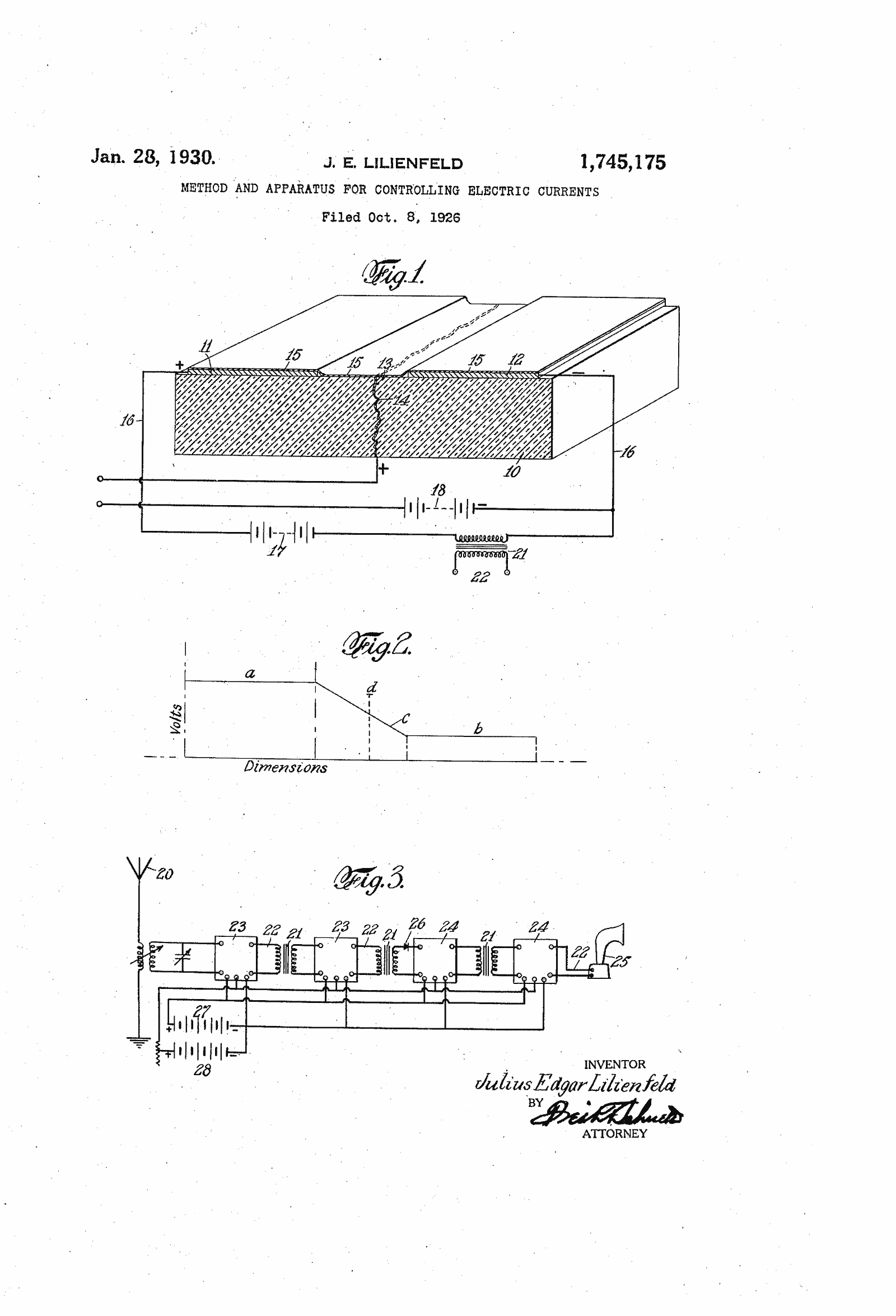
US1745175 was filed on October 8, 1926, after a Canadian filing on October 22, 1925, and granted on January 28, 1930, to Julius Edgar Lilienfeld of Brooklyn, New York. The title is "Method and Apparatus for Controlling Electric Currents." The stated aim is to "dispense entirely" with devices that send electrons through an evacuated space, which is to say, with the vacuum tube.
That is the goal the transistor achieved at Bell Labs in 1947. Lilienfeld wrote it down more than twenty years earlier.
The man and the idea
Lilienfeld was born in Lemberg, now Lviv, in 1882, and joined the physics institute at Leipzig University in 1905. He moved to the United States in 1921 to pursue his patent claims, and in 1926 gave up his Leipzig post to stay.
Radio in the 1920s ran on hot, fragile, power-hungry tubes. Lilienfeld wanted a "simple, substantial and inexpensive" amplifier with no filament in it at all. His idea was to control the flow of current through a solid by applying an electric field from a third terminal. A small signal on that terminal would change how well the solid conducted, and the larger current passing through it would follow the signal.
That is the principle of the field-effect transistor, the type that now fills nearly every computer chip.
Glass, foil and copper sulfide
The device in the patent is strikingly physical. A plate of glass carries two metal coatings on either side of a fine crack. In the crack sits a piece of aluminum foil about a ten-thousandth of an inch thick, its edge flush with the surface. Over everything goes a film of a compound of copper and sulfur.
The foil is the control electrode, and the patent goes on to show the device amplifying radio and audio signals in a receiver circuit. Two more patents followed: US1877140, and US1900018, which describes a thin-film version.
What Lilienfeld could not do was make one work well. Nobody in the 1920s could prepare semiconductor materials pure enough, and he was never able to build a practical device.
Bell Labs meets a patent
The patents were still on the books when John Bardeen, Walter Brattain and the chemist Robert Gibney went to protect their early work at Bell Labs. Most of their claims were rejected because of Lilienfeld. The field-effect idea had been published, in the form of a patent, years before anyone at Bell had thought of it.
Bell's point-contact transistor worked on a different principle, and that is the device that won the Nobel Prize. Decades later the field-effect transistor became the workhorse of electronics, including the integrated circuit.
Lilienfeld was not around for much of the argument. After his laboratory at Ergon closed in 1935 he and his wife, Beatrice, built a house on St. Thomas in the Virgin Islands, partly to escape a wheat allergy, and he kept testing ideas and filing patents. He also patented the electrolytic capacitor, a method used throughout the century. He died in 1963.
The American Physical Society's Lilienfeld Prize, funded by a bequest from Beatrice, has been awarded since 1988. He is remembered in physics now, though few people outside it have heard of the man who described the most manufactured device in history before anyone could make it.
See the original
The full text and figures of US1745175 are on Google Patents.
Related stories

Elijah McCoy Held 57 Patents. 'The Real McCoy' Probably Has Nothing to Do With Him.
The son of people who escaped slavery, Elijah McCoy trained as an engineer in Scotland and came home to a job shoveling coal and oiling engines. His automatic lubricator made him one of the most prolific Black inventors of his age, even if the famous phrase isn't his.
Read the story →
The Insulin Patent Was Sold for a Dollar. Banting Thought a Doctor Shouldn't Be on It at All.
The discoverers of insulin assigned their rights to the University of Toronto for a dollar each. Frederick Banting and J.J.R. Macleod felt that a physician's name did not belong on a patent. The American one carries Banting's name anyway, and the famous quote may not be his.
Read the story →
Gordon Gould Named the Laser in a Notebook. It Took Him Nearly 30 Years to Get Paid.
In November 1957 a Columbia graduate student wrote down how to build a laser and had the notebook notarized at a neighborhood store. He filed too late, was refused clearance to work on it, and spent decades in court before the patents finally paid.
Read the story →
A Lawyer Patented the Automobile Without Building One. Henry Ford Refused to Pay.
George Selden filed for a gasoline road engine in 1879, then kept the application alive for 16 years until there was an industry to tax. Nearly every American carmaker paid up. Henry Ford fought him for eight years and won on a technicality about engines.
Read the story →