A Lawyer Patented the Automobile Without Building One. Henry Ford Refused to Pay.
George Selden filed for a gasoline road engine in 1879, then kept the application alive for 16 years until there was an industry to tax. Nearly every American carmaker paid up. Henry Ford fought him for eight years and won on a technicality about engines.

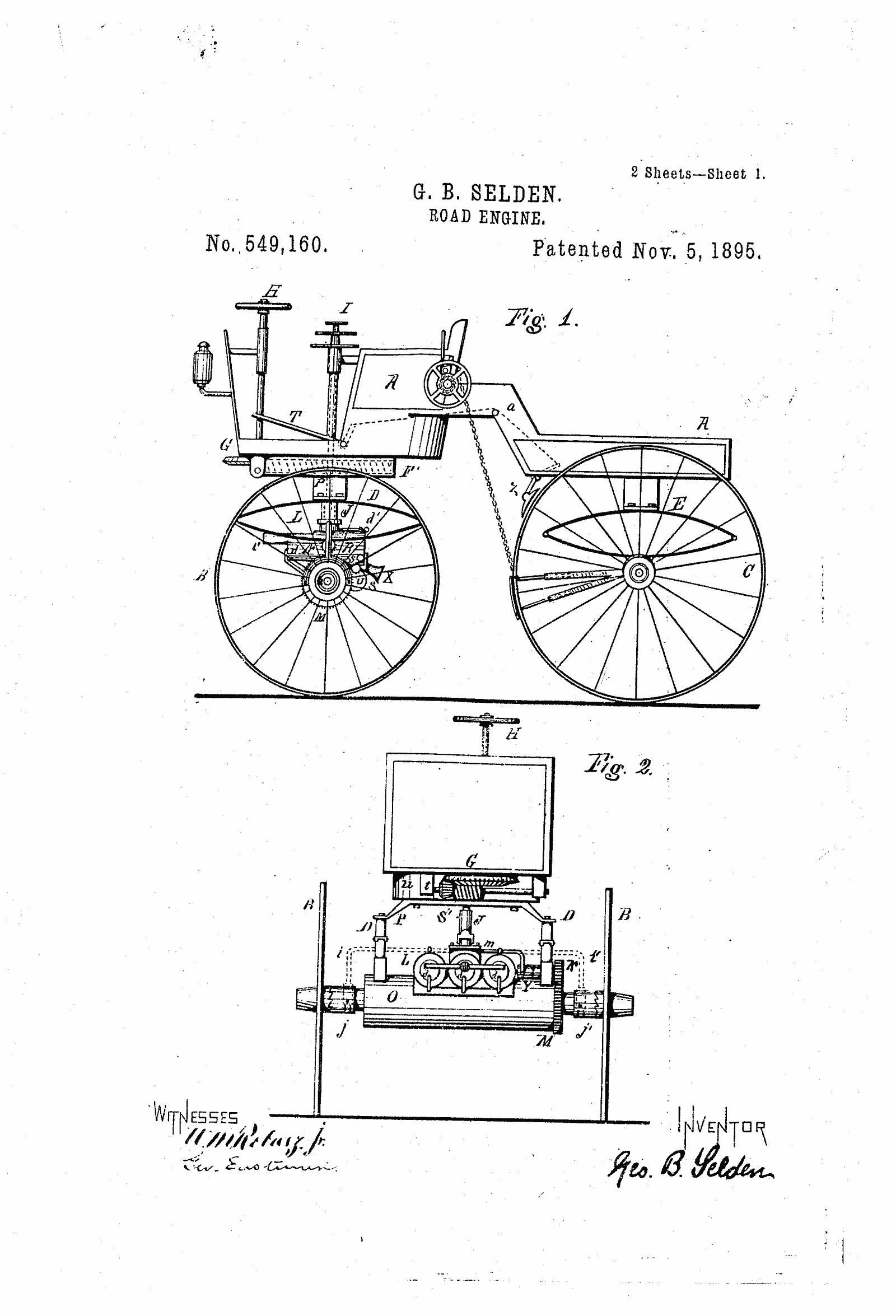
US549160 was filed on May 8, 1879, and granted on November 5, 1895, to George B. Selden of Rochester, New York. The title is "Road-Engine." Between those two dates lie more than 16 years, and the gap was the most valuable thing about it.
Selden was a patent lawyer, admitted to the New York bar in 1871, who liked to tinker. In the 1870s he conceived a road vehicle powered by a compression engine burning liquid hydrocarbon. His application described a body "with any number of seats," driving wheels, and an engine that would do away with steam boilers, water tanks and coal. The claim was broad. Any form of liquid-hydrocarbon engine of the compression type, it said, might be used.
He did not build one. He did something more profitable.
Sixteen years in the patent office
A patent then ran for 17 years from the day it was granted, not from filing. Selden knew the rules better than most, and he used amendments and delays to keep the application pending while the world caught up. By the time it issued in 1895, gasoline cars were running in Europe and the American industry was about to start. His 17 years of protection began just as there was something to protect.
In 1899 he sold the rights to the financier William C. Whitney, in a deal that set a royalty of $15 a car with a $5,000 annual minimum, and a share of 0.75 percent for Selden on licensed cars. A trade group, the Association of Licensed Automobile Manufacturers, formed to collect. Most of the industry signed. Selden himself is estimated to have earned several hundred thousand dollars, without having made the thing he had patented.
Ford says no
Henry Ford founded his company in Detroit in 1903, and he would not pay. The suit that followed lasted eight years and produced a record of some 14,000 pages. Ford testified that Selden "has never advanced the automobile industry in a single particular."
The case became a contest of machines. In 1907 Selden had a car completed from his patent as evidence, 28 years after filing. It is now in the collection of The Henry Ford. It was run on the streets of New York, reportedly at an average of about seven miles an hour. Ford's side built a car of its own around an engine patented by Étienne Lenoir in 1860, to show that others had been there first.
Selden won at trial. Ford appealed, posting a bond of $350,000, and on January 10, 1911, he won. The appeals court held that the patent was valid but narrow. It covered cars using a Brayton engine of the kind Selden had improved, and the industry was building on the Otto engine. No one was infringing.
What was left
The patent had about a year left to run. Selden turned his company to trucks, and died in 1922. Ford came out of the fight with a public reputation as the small man who had beaten a trust, which did the Model T no harm.
Selden's patent is the classic example of what lawyers now call a submarine patent: a broad claim kept out of sight in the patent office until other people have done the work. Since 1995 the term of a US patent has run from the filing date, which closed the trick he used. The argument about broad claims on ideas nobody has built is still going.
See the original
The full text and figures of US549160 are on Google Patents.
Related stories

Elijah McCoy Held 57 Patents. 'The Real McCoy' Probably Has Nothing to Do With Him.
The son of people who escaped slavery, Elijah McCoy trained as an engineer in Scotland and came home to a job shoveling coal and oiling engines. His automatic lubricator made him one of the most prolific Black inventors of his age, even if the famous phrase isn't his.
Read the story →
The Insulin Patent Was Sold for a Dollar. Banting Thought a Doctor Shouldn't Be on It at All.
The discoverers of insulin assigned their rights to the University of Toronto for a dollar each. Frederick Banting and J.J.R. Macleod felt that a physician's name did not belong on a patent. The American one carries Banting's name anyway, and the famous quote may not be his.
Read the story →
Gordon Gould Named the Laser in a Notebook. It Took Him Nearly 30 Years to Get Paid.
In November 1957 a Columbia graduate student wrote down how to build a laser and had the notebook notarized at a neighborhood store. He filed too late, was refused clearance to work on it, and spent decades in court before the patents finally paid.
Read the story →
A Physicist Patented the Transistor Two Decades Before Bell Labs Built One
In 1925 Julius Lilienfeld filed for a solid device that could replace the vacuum tube, using a thin film and an electric field. He never got a working one. But when Bell Labs came to patent the transistor in the late 1940s, his claims were waiting.
Read the story →