Gordon Gould Named the Laser in a Notebook. It Took Him Nearly 30 Years to Get Paid.
In November 1957 a Columbia graduate student wrote down how to build a laser and had the notebook notarized at a neighborhood store. He filed too late, was refused clearance to work on it, and spent decades in court before the patents finally paid.

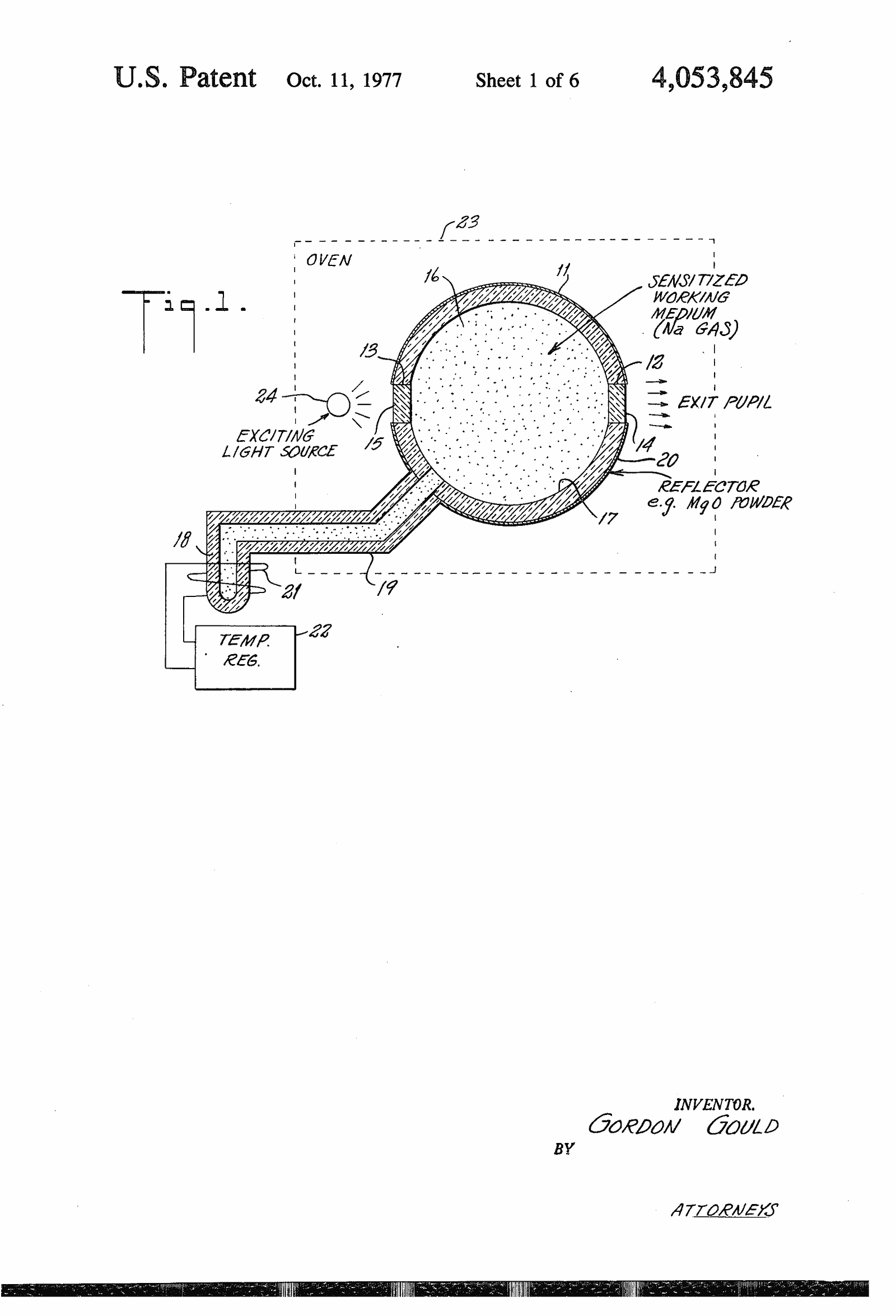
US4053845 was granted on October 11, 1977, to Gordon Gould of New York. The title is "Optically Pumped Laser Amplifiers." The filing date printed on it is August 16, 1974, but the patent traces its claim back through a chain of earlier applications to April 6, 1959. The gap between that date and the grant is the story.
The notebook
Richard Gordon Gould was born in New York in 1920. He had worked on the Manhattan Project from March 1944 until he was dismissed in January 1945 over his membership in the Communist Political Association, and by the 1950s he was a graduate student at Columbia, where Charles Townes, a co-inventor of the maser, was on the faculty.
In November 1957 Gould wrote out a design for a device that would amplify light: an excited medium between two mirrors, the arrangement known as a Fabry-Pérot resonator. His notebook contains the first recorded use of the acronym LASER. He took it to a neighborhood store and had it notarized.
About three months later, Townes and Arthur Schawlow independently saw the importance of the same two-mirror cavity.
The mistake
Gould believed that he needed a working laser before he could patent one. That was wrong, and it was expensive. He left Columbia without finishing his doctorate and joined a company called TRG on Long Island, which won a defense contract to build the device.
Then the project was classified. With his past, he could not get a security clearance, so he was shut out of the work on his own idea. Theodore Maiman at Hughes built the first working laser in 1960.
Schawlow and Townes filed for a patent in July 1958 and received it on March 22, 1960. Gould's first applications did not go in until April 1959. He lost the first round of the fight, in large part because his notebook did not explicitly say that the sidewalls of the medium were transparent.
The long way back
In 1970 Gould bought his patent rights back from Control Data, which had acquired TRG, for $1,000 and a small share of any future profits. His first laser patent, on X-ray generation, had come in 1968. The big one was US4053845 in 1977, which covers optically pumped amplifiers and cites the Schawlow and Townes patent on its front page. A second, US4161436, followed in 1979. Another issued only after a court order in 1985.
By 1977 the laser industry already had sales of about $400 million a year, and it did not want to pay. A company called Patlex, founded in 1979 to handle the licensing, won its first decisive enforcement case in 1987, against Control Laser.
Gould had given up 80 percent of the proceeds to cover the cost of the fight. He still made several million dollars. He held 48 patents by the end, was elected to the National Inventors Hall of Fame in 1991, and died on September 16, 2005, at 85.
The word he wrote in that notebook has outlasted the dispute. Most people who use it have no idea whose it was.
See the original
The full text and figures of US4053845 are on Google Patents.
Related stories

Elijah McCoy Held 57 Patents. 'The Real McCoy' Probably Has Nothing to Do With Him.
The son of people who escaped slavery, Elijah McCoy trained as an engineer in Scotland and came home to a job shoveling coal and oiling engines. His automatic lubricator made him one of the most prolific Black inventors of his age, even if the famous phrase isn't his.
Read the story →
The Insulin Patent Was Sold for a Dollar. Banting Thought a Doctor Shouldn't Be on It at All.
The discoverers of insulin assigned their rights to the University of Toronto for a dollar each. Frederick Banting and J.J.R. Macleod felt that a physician's name did not belong on a patent. The American one carries Banting's name anyway, and the famous quote may not be his.
Read the story →
A Physicist Patented the Transistor Two Decades Before Bell Labs Built One
In 1925 Julius Lilienfeld filed for a solid device that could replace the vacuum tube, using a thin film and an electric field. He never got a working one. But when Bell Labs came to patent the transistor in the late 1940s, his claims were waiting.
Read the story →
A Lawyer Patented the Automobile Without Building One. Henry Ford Refused to Pay.
George Selden filed for a gasoline road engine in 1879, then kept the application alive for 16 years until there was an industry to tax. Nearly every American carmaker paid up. Henry Ford fought him for eight years and won on a technicality about engines.
Read the story →