Elijah McCoy Held 57 Patents. 'The Real McCoy' Probably Has Nothing to Do With Him.
The son of people who escaped slavery, Elijah McCoy trained as an engineer in Scotland and came home to a job shoveling coal and oiling engines. His automatic lubricator made him one of the most prolific Black inventors of his age, even if the famous phrase isn't his.

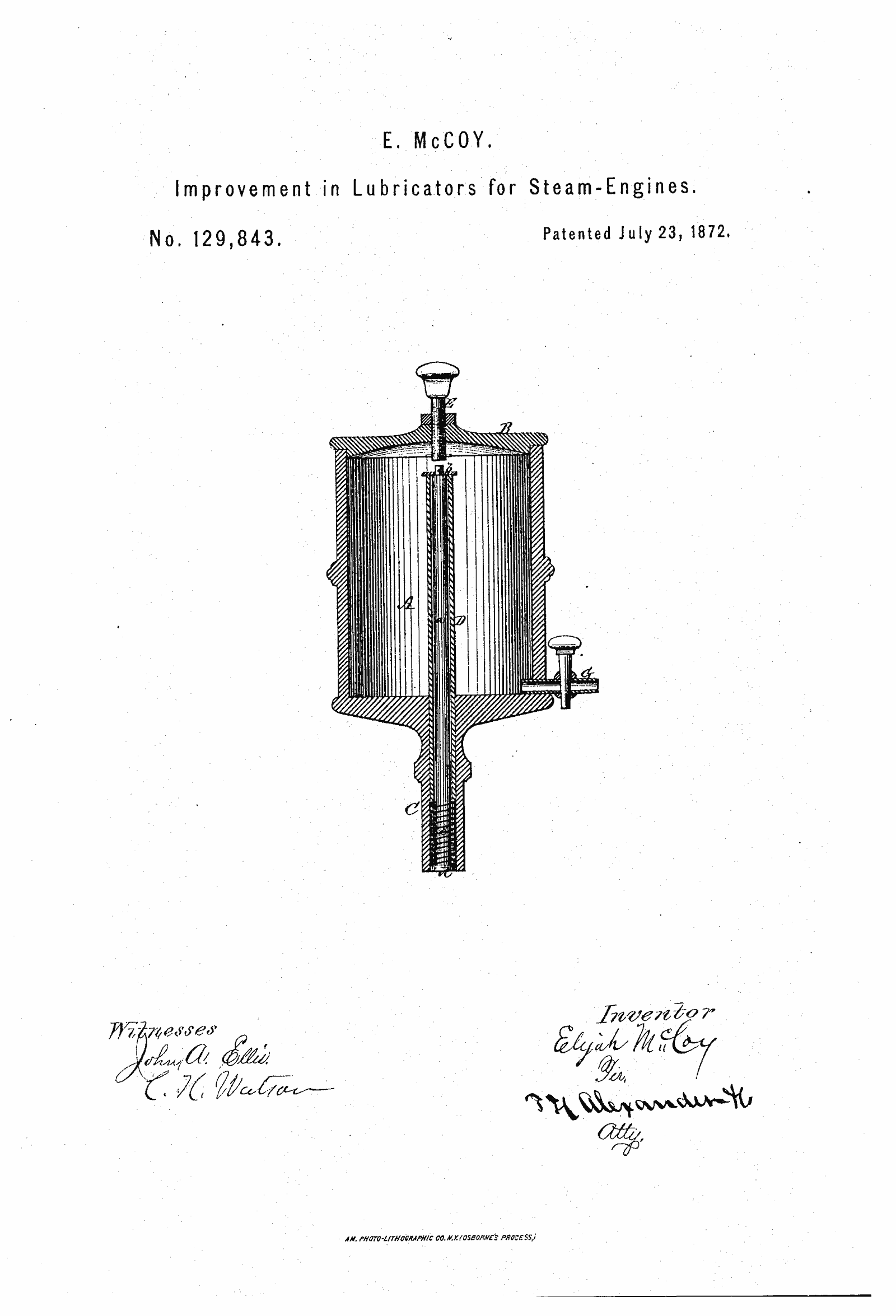
US129843 was granted on July 23, 1872, to Elijah McCoy of Ypsilanti, Michigan, who assigned a share to S. C. Hamlin of the same town. The title is "Improvement in Lubricators for Steam-Engines." It is the first of a long run of patents, as many as 57 by his death, and it is the reason his name comes up every time someone asks where "the real McCoy" comes from.
From Colchester to the coal shovel
McCoy was born on May 2, 1844, in Colchester, Ontario, to George and Mildred McCoy, who had escaped slavery in Kentucky. At 15 he was sent to Scotland, where he apprenticed and studied in Edinburgh and qualified as a mechanical engineer.
When he came to Michigan, the qualification did him little good. The Michigan Central Railroad took him on as a fireman and oiler. It was hard physical work, and one of its chores gave him the idea that made his name.
Oil while it runs
A steam engine's cylinders and bearings need constant lubrication, and in the early years much of that was done by hand, with the machinery stopped. McCoy's patent describes a cup that does the job with the engine's own steam.
An oil cup sits on the engine, with a tube running through it and a rod held by a spiral spring. When steam pressure pushes on a small piston, a valve rises and lets the oil pass. When the pressure falls, the spring closes it again. A thumb-screw in the cover regulates the flow, and a faucet at the bottom draws off condensed steam.
So the engine oils itself in step with its own running, and no one has to walk the machine with a can. He went on improving the idea for decades, and also patented a folding ironing board and a lawn sprinkler.
The phrase
The popular story says that railroad engineers would ask for "the real McCoy" to avoid inferior copies of his lubricator. It is a good story, and it is repeated in many books and on many websites. The evidence does not support it.
The phrase seems to come from Scotland, and it has no known link to his oil cup. The earliest known connection with Elijah McCoy is a 1966 advertisement for Old Taylor bourbon in Ebony magazine, nearly a century after his first patent and decades after his death.
That does not diminish him. A Black engineer in the 1870s, shut out of the job he had trained for, reworked a piece of industrial machinery from the footplate and built a career on it. The story is good enough without the catchphrase.
The end
In 1920, when he was well into his seventies, McCoy finally set up a company under his own name, the Elijah McCoy Manufacturing Company. Two years later he and his wife, Mary, were in a car accident. She died of her injuries. He never fully recovered from his, and he died on October 10, 1929, at 85, at the Eloise Infirmary in Michigan.
See the original
The full text and figures of US129843 are on Google Patents.
Related stories

The Insulin Patent Was Sold for a Dollar. Banting Thought a Doctor Shouldn't Be on It at All.
The discoverers of insulin assigned their rights to the University of Toronto for a dollar each. Frederick Banting and J.J.R. Macleod felt that a physician's name did not belong on a patent. The American one carries Banting's name anyway, and the famous quote may not be his.
Read the story →
Gordon Gould Named the Laser in a Notebook. It Took Him Nearly 30 Years to Get Paid.
In November 1957 a Columbia graduate student wrote down how to build a laser and had the notebook notarized at a neighborhood store. He filed too late, was refused clearance to work on it, and spent decades in court before the patents finally paid.
Read the story →
A Physicist Patented the Transistor Two Decades Before Bell Labs Built One
In 1925 Julius Lilienfeld filed for a solid device that could replace the vacuum tube, using a thin film and an electric field. He never got a working one. But when Bell Labs came to patent the transistor in the late 1940s, his claims were waiting.
Read the story →
A Lawyer Patented the Automobile Without Building One. Henry Ford Refused to Pay.
George Selden filed for a gasoline road engine in 1879, then kept the application alive for 16 years until there was an industry to tax. Nearly every American carmaker paid up. Henry Ford fought him for eight years and won on a technicality about engines.
Read the story →