The Slinky Was a Failed Naval Instrument That Fell Off a Shelf and Walked Away
Richard James was designing springs to stabilize ship instruments in rough seas. He knocked one off a shelf and watched it step end-over-end down a stack of books, onto a table, and onto the floor. He went home and told his wife he thought he had a toy.

US2415012 was granted to Richard T. James on January 28, 1947. The title is "Toy and Process of Use." The toy is the Slinky, and it began life as a piece of shipboard engineering that did not work out.
James was a naval engineer working in Philadelphia during the Second World War on a genuinely difficult problem: how to keep sensitive instruments steady aboard a ship in heavy seas. His approach involved torsion springs — coils that could absorb and damp the motion of the vessel so that a delicate meter or gauge would hold its reading while everything around it pitched.
In 1943, testing samples, he knocked one of the springs off a shelf. Instead of falling in a heap, it uncoiled, caught itself, and walked — flipping end over end down a stack of books, onto a tabletop, off the table, and onto the floor, where it gathered itself back into a neat coil and stood there.
He is supposed to have gone home and told his wife Betty that he thought he could make a toy out of it.
Getting the steel right
The physics of the walking spring is a matter of very specific tolerances. The coil has to be loose enough to extend under its own weight and transfer momentum from one end to the other, but tight enough to recover and re-stack rather than tangling. Too stiff and it just sits there. Too slack and it collapses into a knot.
James spent about two years finding the right combination of steel gauge, coil diameter, and tension. The production Slinky is roughly eighty feet of flat steel wire wound into about ninety coils — a specification that has barely changed since.
Betty James named it. She went through the dictionary looking for a word for the movement and settled on slinky, a Swedish-derived word meaning sleek or sinuous.
The demonstration problem
The Jameses borrowed five hundred dollars, had four hundred units made, and could not sell them. A Slinky sitting in a box on a shelf looks like exactly what it is — a plain metal spring — and no shopper in 1945 had any reason to pick one up.
The fix was demonstration. In November 1945 they got permission to set up an inclined board at the Gimbels department store in Philadelphia and show the thing actually walking. The entire stock of four hundred, at a dollar each, sold in about ninety minutes.
More than three hundred million Slinkys have been sold since. The company, James Industries, was run for decades out of Hollidaysburg, Pennsylvania, and the toy is still manufactured on the original type of machinery.
The part that isn't cheerful
The Slinky made a fortune and then nearly lost it. In 1960 Richard James left his wife and six children, gave a large share of the company's money to a religious group in Bolivia, and moved there permanently. Betty James took over a business that was deep in debt, moved it to her hometown, cut costs, and rebuilt it — running James Industries successfully for the next thirty years and becoming, eventually, an inductee of the Toy Industry Hall of Fame in her own right.
The spring that fell off the shelf made two careers. Only one of the two people involved stuck around for it.
See the original
The full text and figures of US2415012 are on patents.us.
Related stories
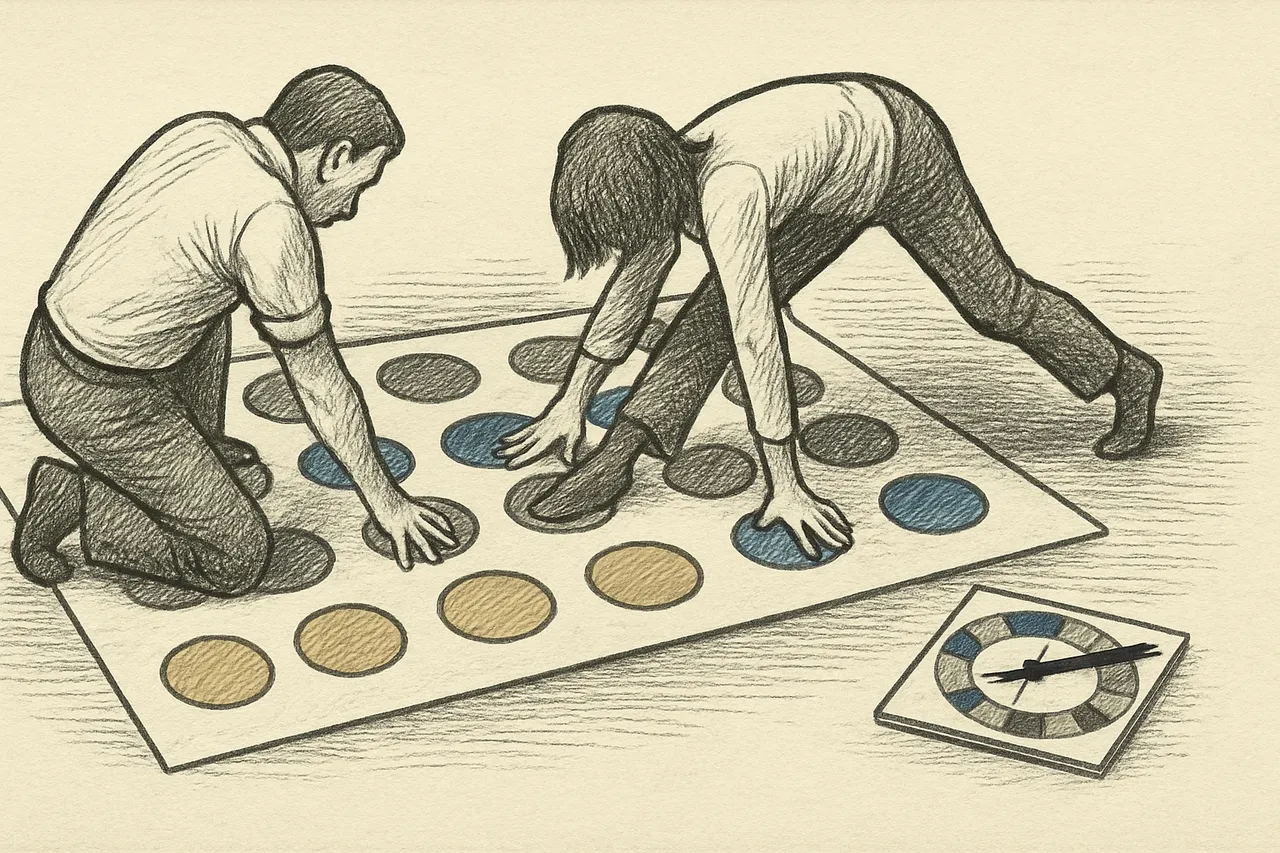
Twister's Patent Is Titled 'Apparatus for Playing a Game Wherein the Players Constitute the Game Pieces'
The patent title is the whole idea: the people are the pieces. Milton Bradley released the game in 1966, some retailers were wary of it, and critics found it a little too intimate. Then Johnny Carson played it on television with Eva Gabor, and the orders poured in.
Read the story →
Ernő Rubik Needed About a Month to Solve His Own Cube. An American Court Later Found It Infringed an Earlier US Patent.
Rubik built the first cube in Budapest in 1974 as a way to think about three-dimensional movement. The clever part is how it holds together when most of its pieces are not attached to anything. In the United States, a chemist named Larry Nichols had patented a related puzzle in 1972, and his company sued.
Read the story →
A Dentist Co-Invented the Cotton Candy Machine, and It Was Sold at the 1904 World's Fair as Fairy Floss
William Morrison was a dentist and John Wharton was a candy maker. Their machine melted sugar and flung it through tiny holes so that it cooled into threads finer than hair before it could crystallize. They filed in 1897, and at the St. Louis World's Fair it was a sensation.
Read the story →
Coca-Cola Asked Glassmakers for a Bottle You Could Recognize in the Dark, or Broken on the Ground
In 1915 Coca-Cola had an imitation problem, since competitors used the same straight-sided bottles and borrowed-sounding names. It challenged glass companies to design a bottle identifiable by touch alone. The winner came from a small glassworks in Terre Haute, Indiana, and the name on the patent is not the name of the man who drew it.
Read the story →