The Man Who Patented the Pringles Can Was Buried in One
Procter & Gamble chemist Fredric Baur was asked to fix the potato chip bag: too much air, too many broken chips. His answer was a stack of identical saddle-shaped crisps in a sealed tube. When he died in 2008, his family put part of his ashes in one.

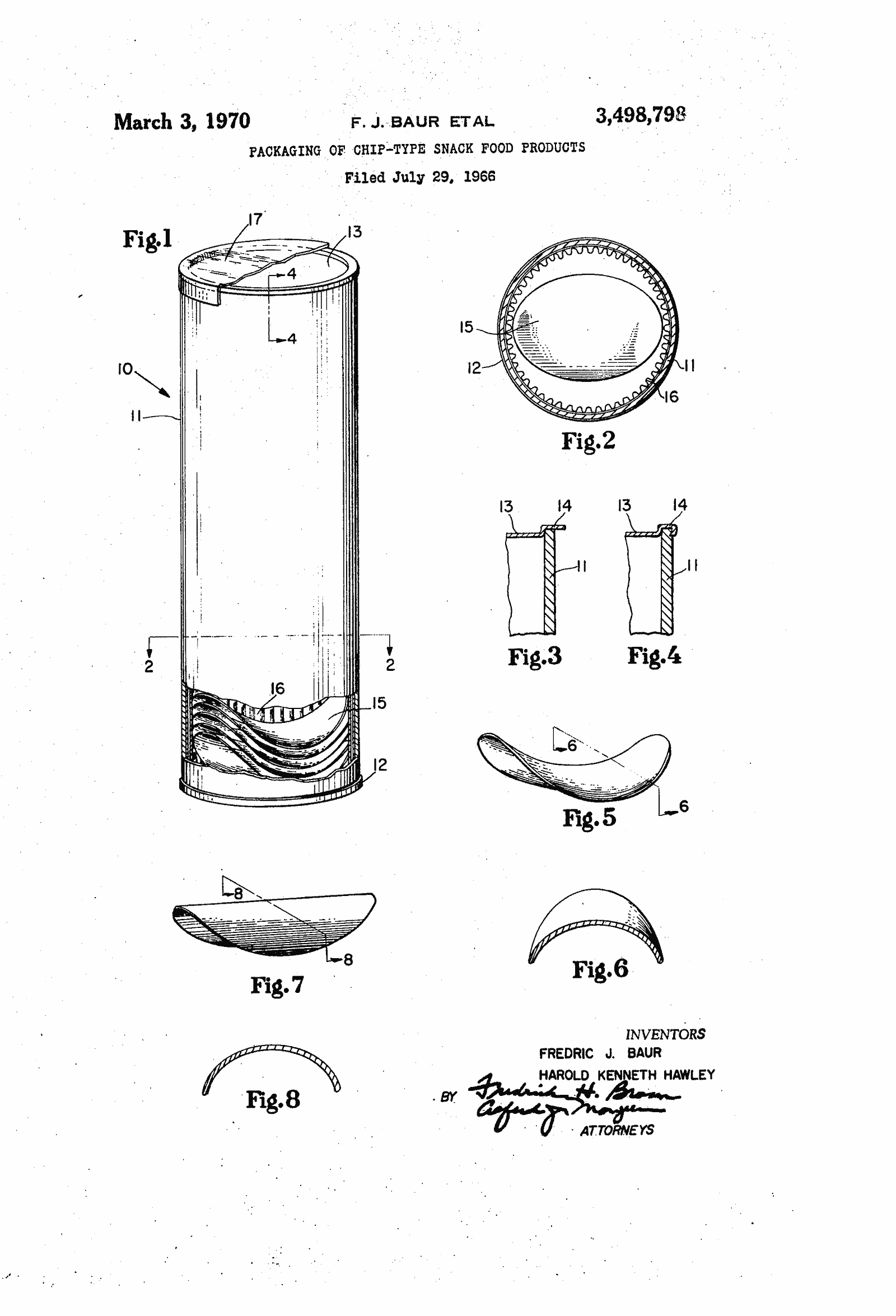
US3498798 was filed on July 29, 1966, and granted on March 3, 1970. The title is "Packaging of Chip-Type Snack Food Products." The inventors are Fredric J. Baur of Cincinnati and Harold Kenneth Hawley of Springfield, Ohio, and it was assigned to the Procter & Gamble Company. It is the Pringles can.
The patent starts with a complaint any snack buyer would recognize. Chips were packed at random into bags of waxed paper or glassine. That gave them little protection, so it was "quite common" to find broken chips inside. A loose bag also held a good deal of oxygen and water vapor, and let in more. Oxygen turned the frying fat rancid, and moisture took away the crispness.
Two years and a saddle
Baur, a chemist, had been given the problem by Procter & Gamble in 1956. He spent about two years on it and arrived at the essential answer: stop treating chips as random objects. If every chip were the same size and the same saddle shape, they could be stacked one on another with almost no air between them, and a stack of curved chips is strong in a way that a pile of flat ones is not.
The patent is frank about why the saddle. It is the general shape potato chips already had, a form consumers were familiar with. Its compound curve also stiffens each chip. In mathematics the shape is called a hyperbolic paraboloid, and it is one of the few things in a grocery store with its own entry in a geometry textbook.
The package finishes the job. The stack goes into a rigid tube made from materials that keep out oxygen and water vapor, and the claims describe filling it with an inert gas such as nitrogen before sealing the ends. The chips arrive whole, and they stay fresh far longer.
A chip nobody wanted to eat
The package was the easy part. Baur could not make the crisps taste good enough, and he was moved to other work. In the mid-1960s another researcher, Alexander Liepa, revived the project and improved the flavor. Gene Wolfe, a mechanical engineer who later became a celebrated science fiction novelist, helped develop the machine that cooked them.
Procter & Gamble first sold Pringles in Indiana in 1968. Rival chip makers objected that a product made from dough was not a potato chip, and in 1975 the Food and Drug Administration agreed in part, allowing the word only in the phrase "potato chips made from dried potatoes." The brand moved to calling them crisps. Kellogg's bought it in 2012 for $2.695 billion.
The last request
Baur was proud of the can, and he told his children so. He died on May 4, 2008, at 89, and they did as he had asked. Part of his cremated remains went into a Pringles can, which was buried in his grave in Cincinnati along with an urn holding the rest. His son Larry said the can was bought at a store a few hours before the burial.
Most inventors are remembered, if at all, by a line in a patent index. Baur saw to it that he would be buried with his work.
See the original
The full text and figures of US3498798 are on Google Patents.
Related stories

Mary Kenner Designed a Sanitary Belt in the 1920s. A Company Dropped It When It Learned She Was Black.
Mary Beatrice Davidson Kenner came up with an adjustable sanitary belt as a young woman and could not afford to patent it for 30 years. When a company finally showed interest, it walked away on learning she was Black. She went on to earn five patents while working as a florist.
Read the story →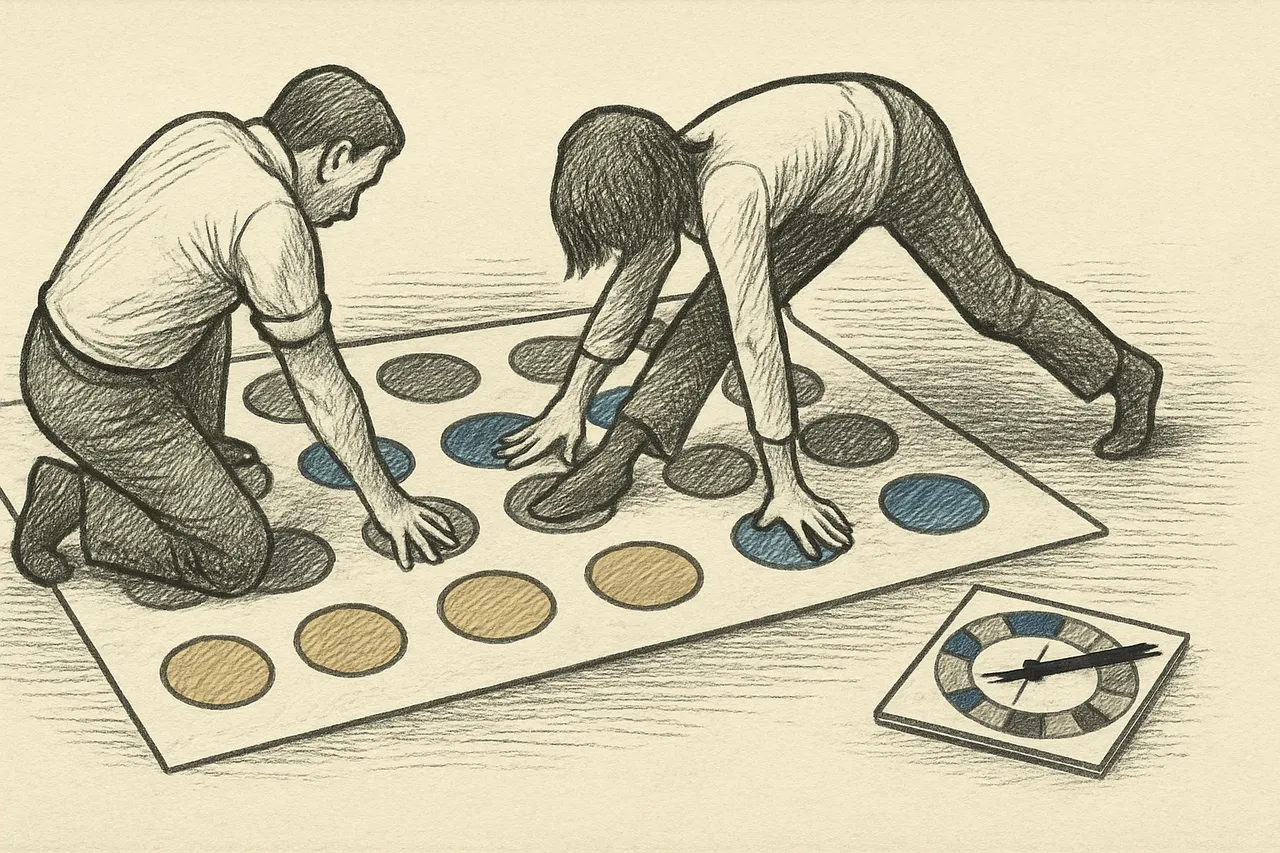
Twister's Patent Is Titled 'Apparatus for Playing a Game Wherein the Players Constitute the Game Pieces'
The patent title is the whole idea: the people are the pieces. Milton Bradley released the game in 1966, some retailers were wary of it, and critics found it a little too intimate. Then Johnny Carson played it on television with Eva Gabor, and the orders poured in.
Read the story →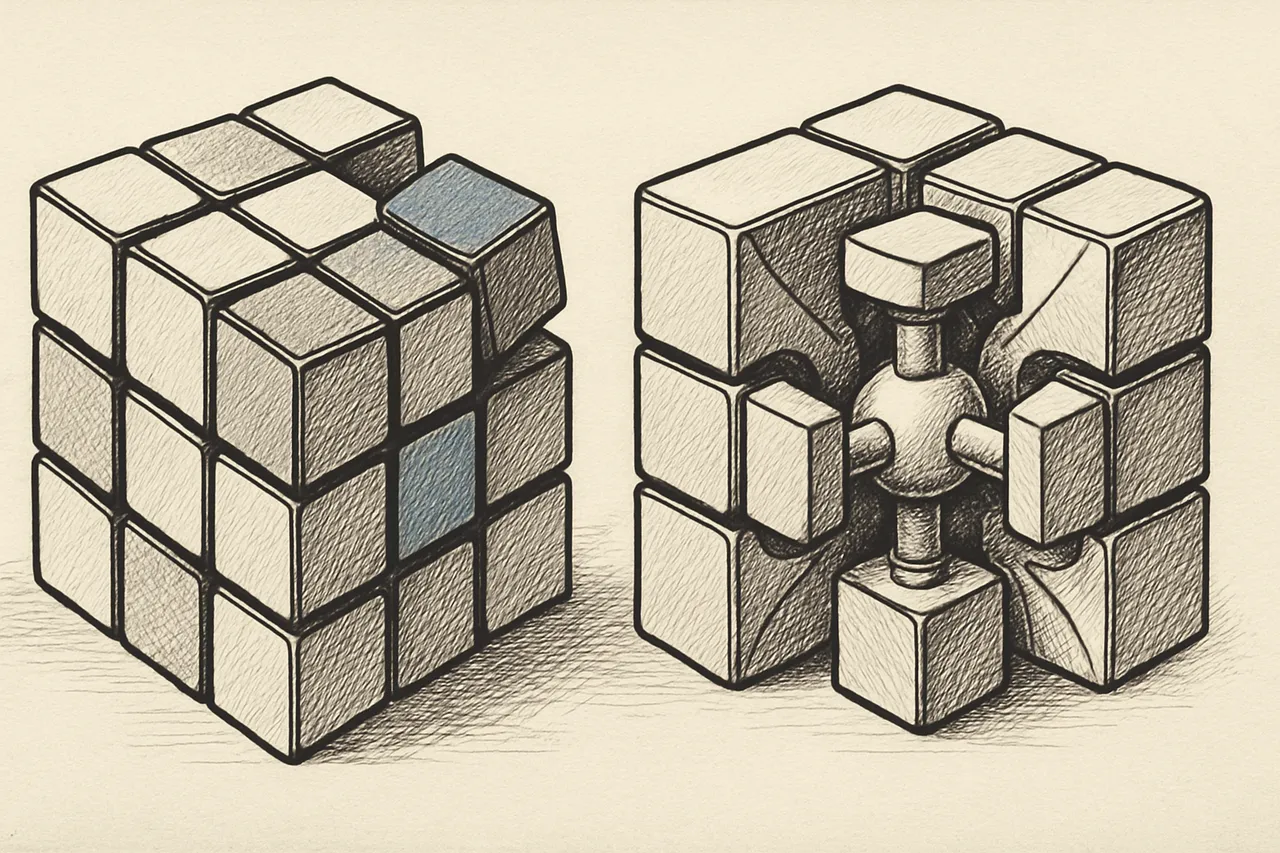
Ernő Rubik Needed About a Month to Solve His Own Cube. An American Court Later Found It Infringed an Earlier US Patent.
Rubik built the first cube in Budapest in 1974 as a way to think about three-dimensional movement. The clever part is how it holds together when most of its pieces are not attached to anything. In the United States, a chemist named Larry Nichols had patented a related puzzle in 1972, and his company sued.
Read the story →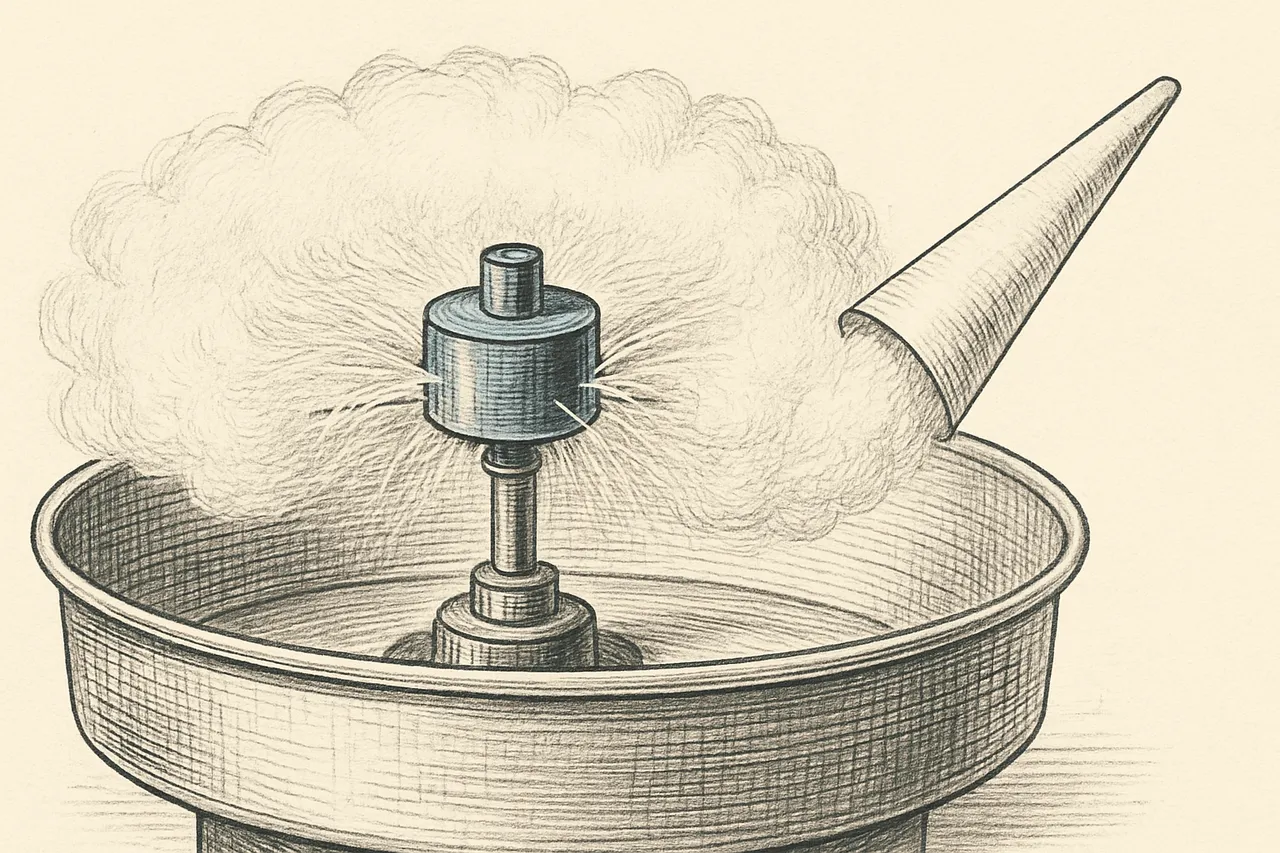
A Dentist Co-Invented the Cotton Candy Machine, and It Was Sold at the 1904 World's Fair as Fairy Floss
William Morrison was a dentist and John Wharton was a candy maker. Their machine melted sugar and flung it through tiny holes so that it cooled into threads finer than hair before it could crystallize. They filed in 1897, and at the St. Louis World's Fair it was a sensation.
Read the story →