He Reached Into the Wrong Bin, Soldered in the Wrong Resistor, and Built the First Implantable Pacemaker
Wilson Greatbatch was building a device to record heart sounds. He grabbed a resistor of the wrong value, and the circuit started pulsing instead of recording. He recognized the rhythm immediately, because he already knew what problem it solved.
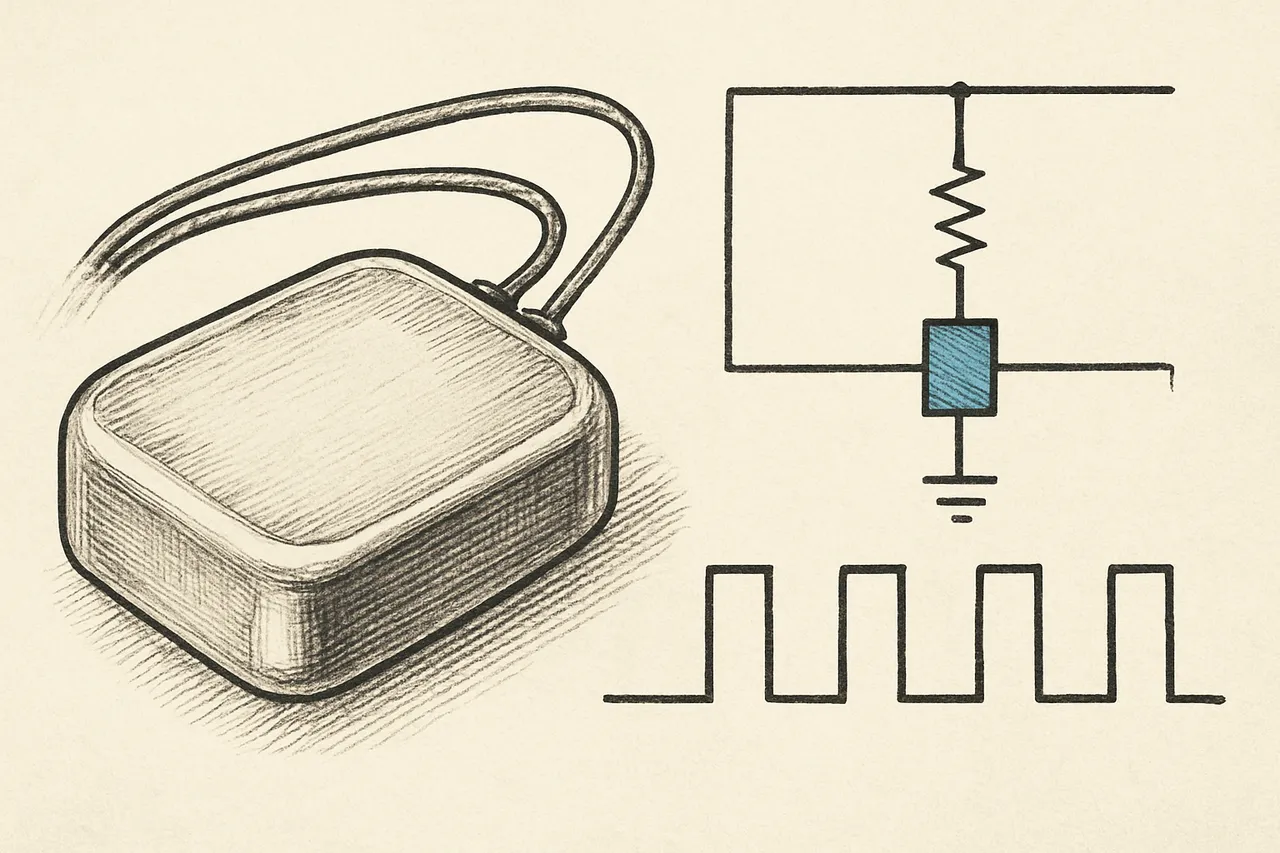
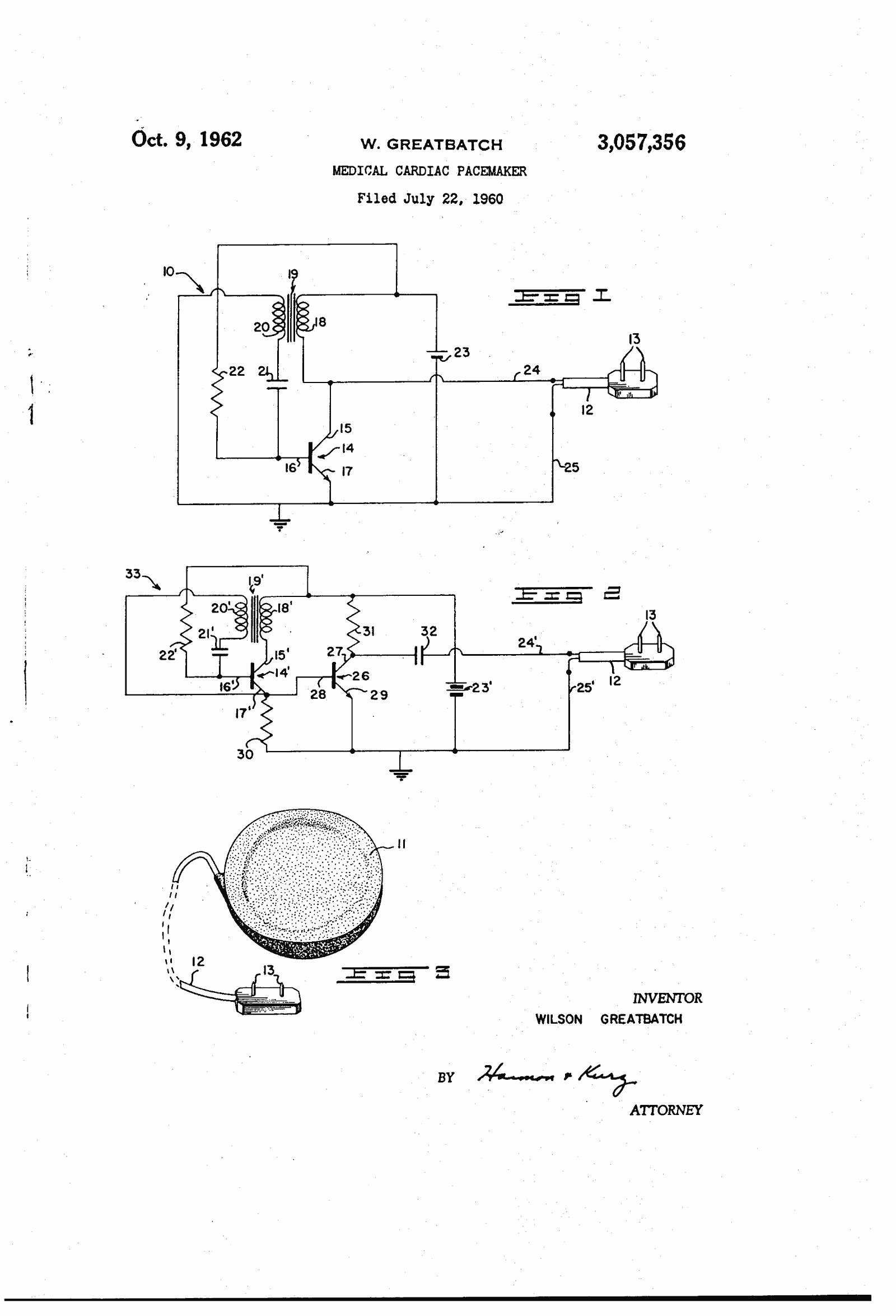
US3057356 was filed by Wilson Greatbatch on July 22, 1960, under the title Medical Cardiac Pacemaker. It describes a device small enough and sealed well enough to be placed inside a human body and left there, and it exists because of a mistake at a workbench.
What he was actually building
Greatbatch was an electrical engineer in Buffalo, New York, working in the late 1950s on an oscillator circuit intended to record heart sounds. Recording, not stimulating.
He reached for a resistor to complete the circuit. The value he needed and the value he picked up were different, and accounts of the specific figures vary in the retelling, so the detail that matters is the effect rather than the numbers. With the wrong resistor in place, the circuit stopped behaving like a recorder and began putting out a regular electrical pulse: a short pulse, then a pause, then another.
He listened to the rhythm and recognized it. It sounded like a heartbeat.
Why he was ready for it
This is the part of the story that gets skipped, and it is the reason the accident amounted to anything.
Years earlier, while working on a different project, Greatbatch had sat at lunch with two surgeons who described a condition called complete heart block, in which the electrical signal that tells the heart's ventricles to contract fails to arrive from the atria. The heart has functioning muscle. The wiring has failed. Patients died from a signaling fault in an organ that was otherwise capable of working.
He had carried that around for years. So when a circuit on his bench began emitting a steady pulse, he was not looking at an anomaly. He was looking at the missing signal for a problem he had been told about and had never stopped thinking about.
Nothing about the accident was useful on its own. Somebody else with that resistor gets a broken recorder.
The problem that was harder than the circuit
Pacing a heart electrically was not new in 1960. External pacemakers existed. They were large, they ran on mains power or bulky batteries, and the patient was tethered to the machine by wires passing through the skin, which is both immobilizing and a standing infection risk.
The circuit Greatbatch had was small and drew very little power. The real engineering problem was keeping the body and the electronics apart.
The human interior is warm, salty, wet, and chemically aggressive. It will destroy unprotected electronics, and leaking components will injure the patient. Greatbatch worked on sealing the device, eventually using epoxy and later moving to hermetic metal enclosures, so that the unit could sit inside a person and simply continue working.
The first implant in a human came in 1960, in a patient at the Veterans Administration hospital in Buffalo, in work with the surgeon William Chardack. The device was tested in dogs first.
The battery, which he also solved
Early implantable pacemakers ran on mercury batteries with short and unpredictable lives, which meant surgery to replace a unit every couple of years. That is a serious cost in an implanted device.
Greatbatch went after this problem too, and adapted the lithium iodide battery for implantable use. It extended pacemaker life dramatically, to a decade or more, and it became the standard. This is arguably as important as the pacemaker circuit itself, and it is far less well known.
He founded a company to manufacture the batteries and held more than 300 patents. He received the National Medal of Technology in 1990 and was inducted into the National Inventors Hall of Fame in 1988.
Millions of people are alive with one of these in their chest. The circuit that started it was an oscillator that had been built wrong, noticed by the one person who already knew what the right kind of wrong sounded like.
See the original
The full text and figures of US3057356 are on Google Patents.
Related stories
Fermi and Szilard Filed a Patent on the Nuclear Reactor in 1944. It Stayed Secret for More Than Ten Years.
The patent is titled Neutronic Reactor, which is a very flat name for the machine that produced the first controlled nuclear chain reaction. It was filed during the Manhattan Project, buried under a secrecy order, and not published until 1955, six months after Enrico Fermi died.
Read the story →
The 1868 Patent Behind the First Successful Typewriter Had Its Keys in Alphabetical Order. QWERTY Came Later, and Nobody Fully Agrees Why.
Christopher Latham Sholes and two partners patented a typewriter in Milwaukee in 1868 with keys arranged like a piano, roughly in alphabetical order. Over the next several years the letters were shuffled into QWERTY. The popular explanation for that is a distortion of a better one.
Read the story →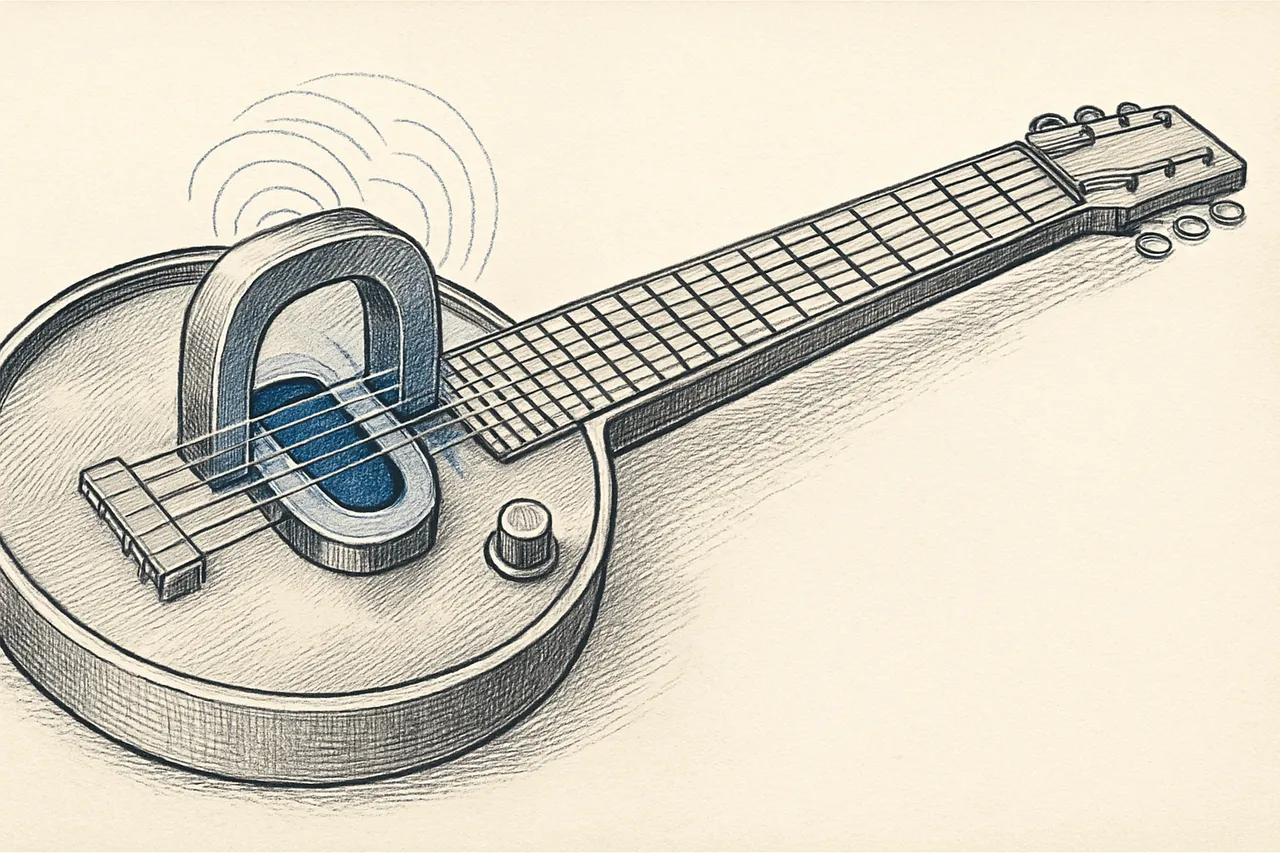
The First Electric Guitar You Could Buy Was Nicknamed the Frying Pan, and Its Patent Took Three Years
In the big band era, guitarists could not be heard over the horns. George Beauchamp set the strings inside a pair of horseshoe magnets, wound a coil beneath them, and mounted it all on a round aluminum body with a long neck. It looked like cookware, and the magnetic pickup it used is still how electric guitars work.
Read the story →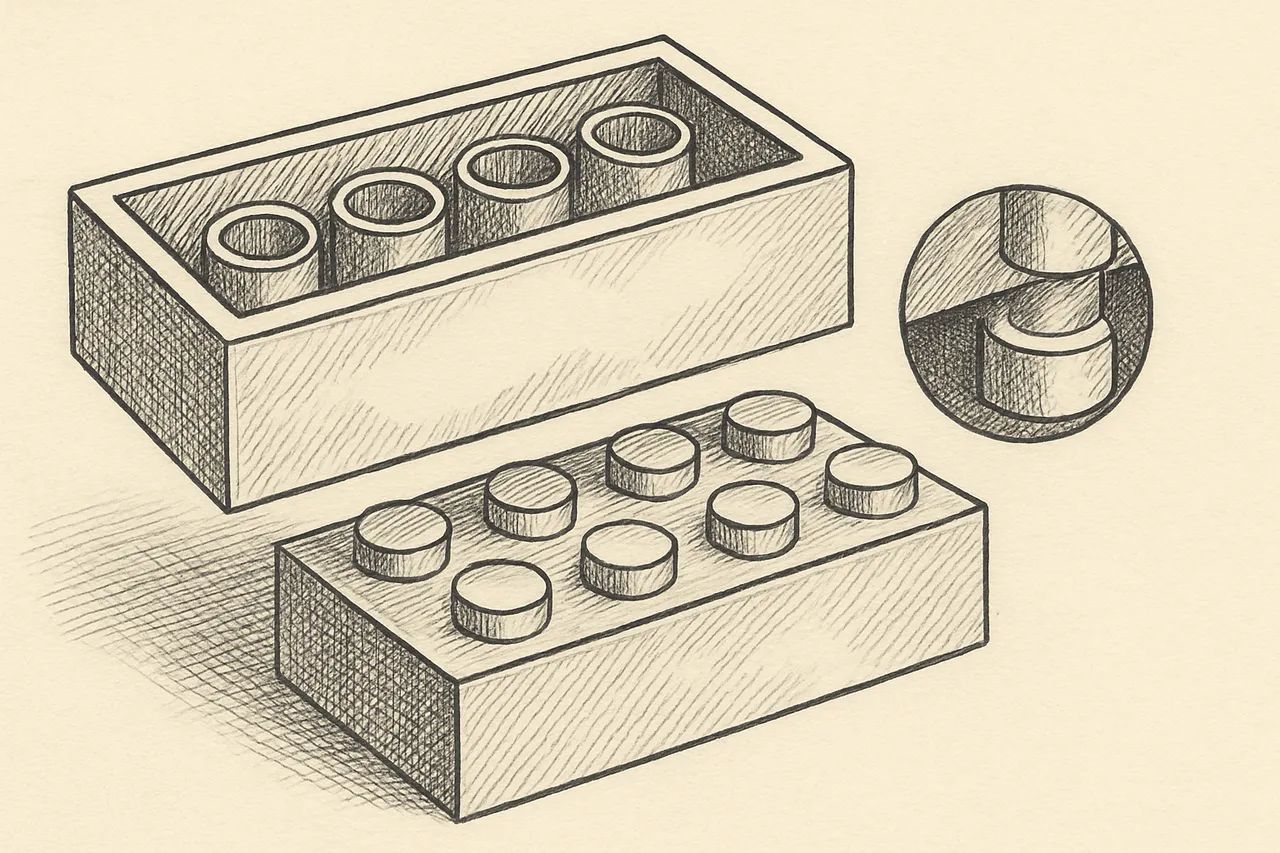
LEGO Bricks Were on Sale for Nine Years Before They Held Together Properly. The Fix Was a Row of Hollow Tubes.
The first LEGO bricks had studs on top and an empty space underneath, so models tended to come apart when you picked them up. Godtfred Kirk Christiansen's 1958 design put tubes inside the brick, and a brick molded that year still fits one molded today.
Read the story →