Houdini Patented a Diving Suit You Could Escape From in Under 45 Seconds
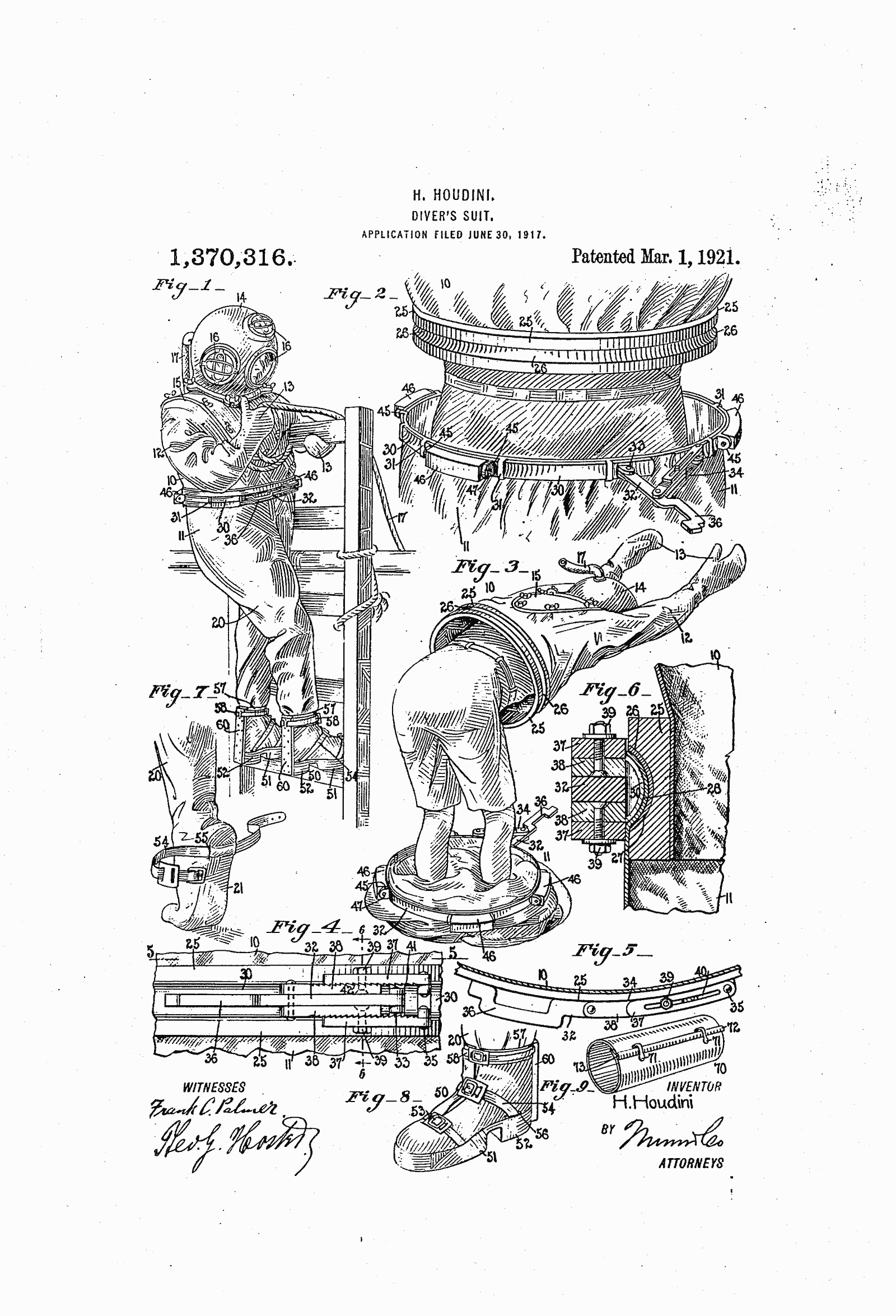
The world's most famous escape artist held one patent, and it was for an escape. Houdini's 1921 diver's suit splits at the waist so a diver in trouble can open it from inside and swim free. His patent says even a beginner could get out in under 45 seconds.

US1370316 was filed on June 30, 1917, and granted on March 1, 1921, to Harry Houdini of Brooklyn, New York. The title is "Diver's Suit." It is the only patent the world's most famous escape artist ever received, and naturally it is about getting out of something.
The problem with a diving suit
A diver of the period wore a heavy suit of rubberized fabric with a metal helmet, and depended entirely on the air line and on the crew above. If the line fouled, or the air failed, he was trapped in it.
Houdini's patent sets out four goals. The main one is to let the diver, "in case of danger for any cause whatever, to quickly divest himself of the suit while being submerged and to safely escape and reach the surface of the water." The others: to let a diver put the suit on or take it off without help, to keep him from being crushed if the air gave out, and to let him go down and come up faster than usual.
Two halves
The solution is to build the suit in two sections, upper and lower, that meet at the waist. A band of rubber on one overlaps the other, and the two are held together by fastenings on the outside that the diver closes before going down and can open himself while submerged. A strong metal band and a belt at the waist keep the soft material from collapsing onto his body under pressure.
To escape, the diver releases the fastenings, steps out of the lower half, draws himself out of the upper one, and rises.
Then comes the line that only Houdini would put in a patent. "By actual tests," it says, "it has been proved that not only a diver but an inexperienced person when submerged can escape from the suit in less than 45 seconds."
The escape artist as engineer
Houdini, born Erik Weisz in Budapest in 1874, made his name with underwater escapes from handcuffs, packing crates and a water-filled tank. He knew more than most people about getting free of things under water, and he knew it could be engineered.
There is little sign that his suit went into service. Divers' equipment moved on, and the idea of a suit that comes apart at the waist was a hard one to sell to people whose lives depended on it staying together. Houdini died on October 31, 1926.
The patent remains a neat summary of the man. Everyone else was trying to keep the water out of the suit. He was the one thinking about how to get out of it.
See the original
The full text and figures of US1370316 are on Google Patents.
Related stories

A Rochester Woman Patented a Device for Pressing Dimples Into Your Cheeks
In 1923 Evangeline Isabella Gilbert applied for a patent on a spring-wire frame that hooked over the ears and pressed two small knobs into the cheeks, where dimples were wanted. It was granted in 1927, and the newspapers had fun with it for years.
Read the story →
Chicken Eyeglasses Were Patented in 1903, and Farmers Really Bought Them
Hens peck each other, sometimes to death. In 1903 Andrew Jackson Jr. of Munich, Tennessee, patented a tiny pair of spectacles for chickens. Later versions came with rose-colored lenses, on the theory that a hen who cannot see blood will not go after it.
Read the story →
In 1896 a Man From Spokane Patented a Hat That Tipped Itself When You Bowed
Raising your hat to a lady was basic manners in the 1890s, and it took a free hand. James C. Boyle's clockwork saluting device lifted the hat, spun it and put it back down every time the wearer nodded. He also suggested it would make a fine advertisement.
Read the story →
The Coffin Torpedo Was Patented to Shoot Grave Robbers
In 1878, as medical schools bought stolen bodies and a president's son turned up in a medical college, Philip Clover of Columbus, Ohio, patented a spring-loaded gun that went inside a coffin and fired if anyone tried to take the body.
Read the story →