Buckminster Fuller Patented a Dome That Gets Stronger as It Gets Bigger
Most structures get weaker and heavier as they scale up. Buckminster Fuller's geodesic dome does the opposite — it grows more efficient the larger it becomes. It was too strange for mainstream architecture, but it went to the South Pole, the World's Fair, and the cover of the future.
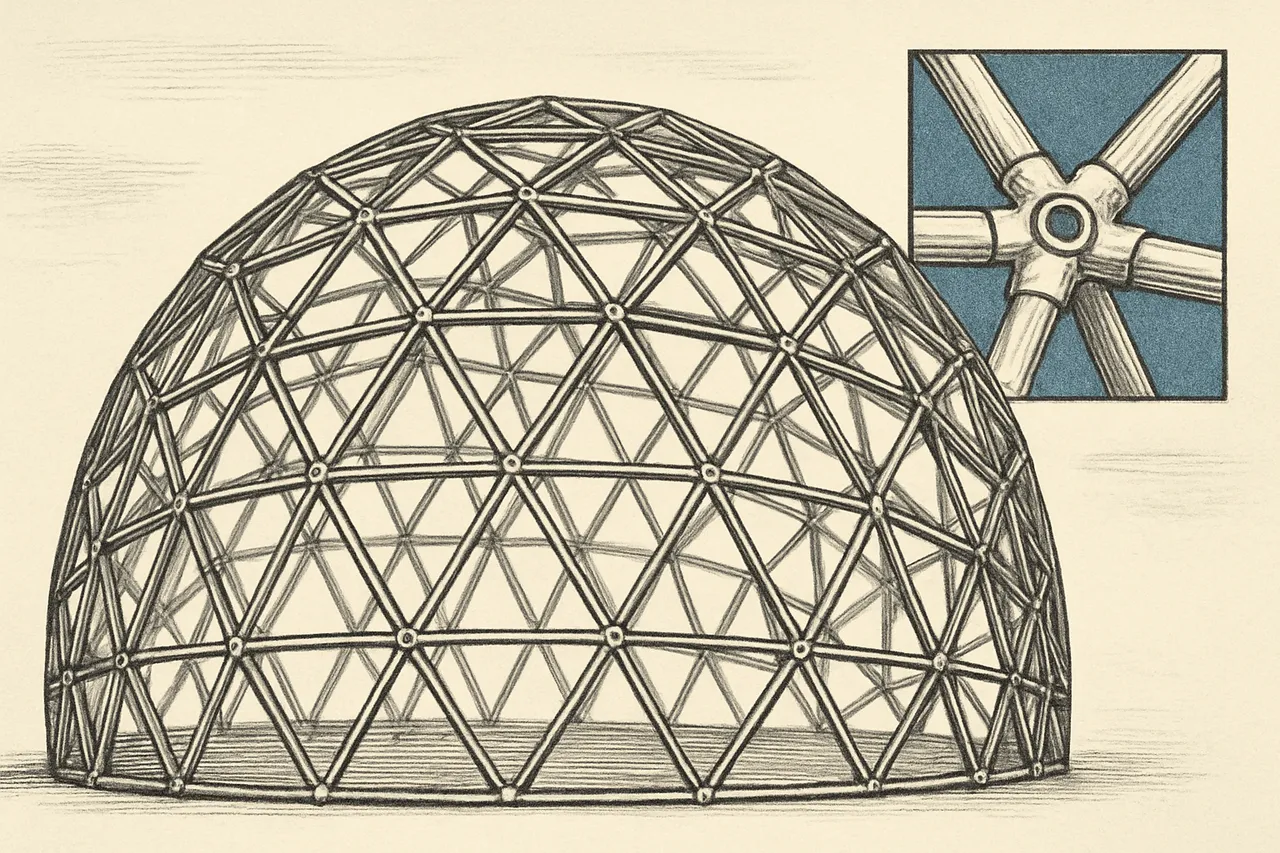
US2682235 was granted to Richard Buckminster Fuller on June 29, 1954. The title is "Building Construction." It describes the geodesic dome — a spherical or partial-spherical structure built from a lattice of triangles — and it embodies the central obsession of Fuller's long, strange, brilliant career: doing the most with the least.
Fuller was an architect, designer, philosopher, and self-styled "comprehensive anticipatory design scientist" who spent his life looking for ways to give humanity more shelter, more mobility, and more resources using dramatically less material and energy. He called the principle "ephemeralization" — the tendency of technology to accomplish more and more with less and less. The geodesic dome was his most successful demonstration of it.
Why the triangle matters
The engineering insight is genuinely elegant. Most building shapes rely on rectangles and right angles, which are inherently unstable — a rectangle racks and collapses into a parallelogram unless braced. A triangle cannot deform without changing the length of its sides, so it is intrinsically rigid. Fuller's dome distributes structural stress across a network of triangles wrapping a sphere, so that a load applied anywhere is shared by the whole structure rather than borne by a few beams.
The remarkable consequence is one that runs against normal engineering intuition: the geodesic dome becomes proportionally stronger and more efficient as it gets larger. Ordinary structures face the "square-cube law" — as they scale up, their weight grows faster than their strength, which is why you cannot simply build a skyscraper the shape of a cottage. The dome inverts this. A very large geodesic dome uses astonishingly little material for the volume it encloses, and there is, in principle, no upper size limit at which it would collapse under its own weight. Fuller liked to speculate about domes miles across, roofing entire cities.
Ahead of its time
Domes were built. Thousands of them. They sheltered radar installations in the Arctic (the "radomes" of the Distement Early Warning Line), housed the US pavilion at the 1967 Montreal World's Fair as a shimmering globe, covered auditoriums and greenhouses and the occasional adventurous home. The dome became an icon of futurism, countercultural architecture, and the whole-Earth idealism of the 1960s and 70s.
But the geodesic dome never became mainstream construction, and the reasons are as instructive as the invention. Domes are wonderful at enclosing large empty volumes efficiently, but human buildings are full of rectangular things — rooms, doors, furniture, floors — that fit awkwardly inside a sphere. They are notoriously difficult to seal against leaks, because a dome has so many angled joints. They resist subdivision and expansion. The very efficiency that makes them brilliant for a stadium or a radar station makes them impractical for a normal house.
So Fuller's dome occupies a particular and honorable place in the archive: a genuinely superior solution to a problem that most buildings do not actually have. It was not wrong. It was aimed at a future — of vast enclosed spaces, of doing radically more with less — that has only partly arrived. Fuller's name lives on in an unexpected place: when scientists discovered a soccer-ball-shaped molecule of sixty carbon atoms in 1985, its structure so resembled his domes that they named it the "buckminsterfullerene," or buckyball, in his honor.
See the original
The full text and figures of US2682235 are on patents.us.
Related stories
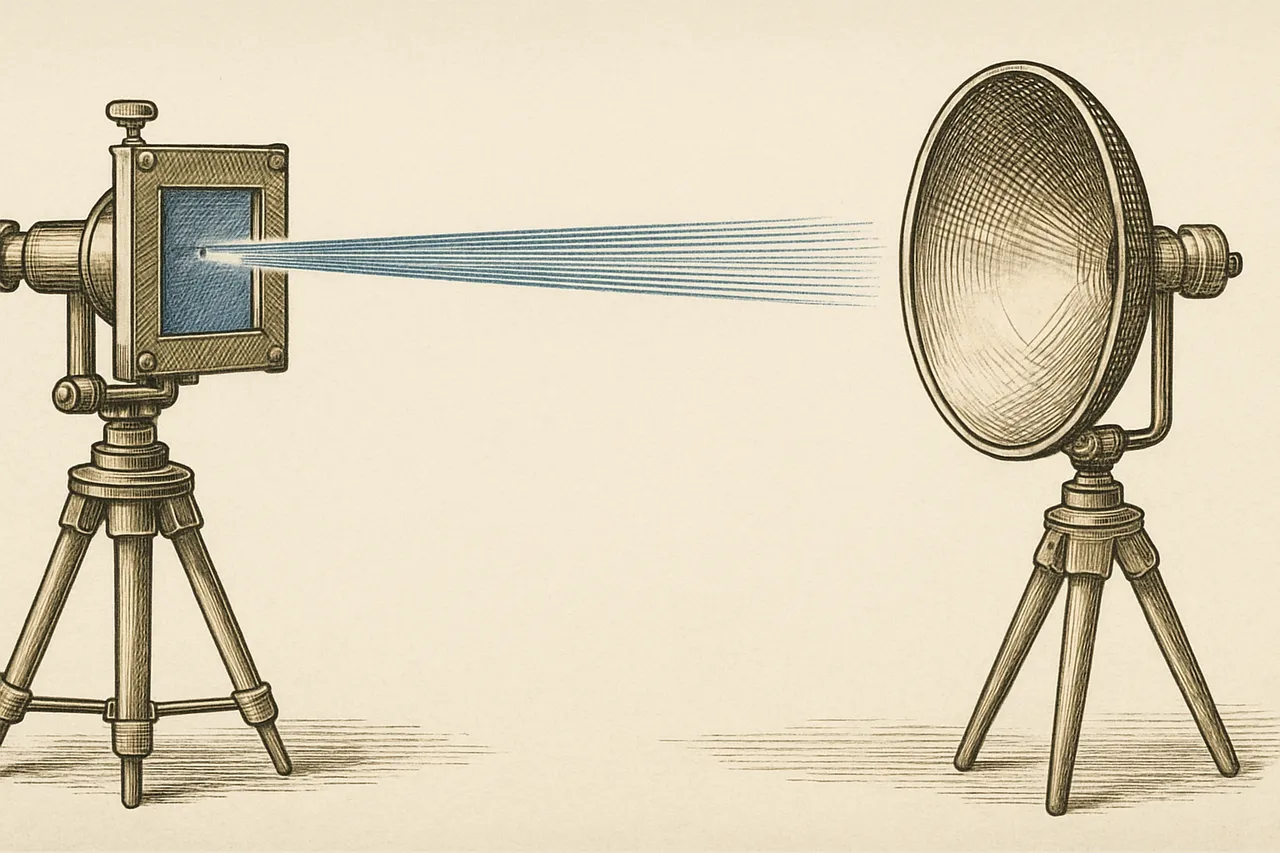
Bell Called It His Greatest Invention. It Sent Speech on a Beam of Light — in 1880.
Alexander Graham Bell thought the photophone, not the telephone, was his finest work. It transmitted the human voice on a beam of sunlight, with no wires at all. It was also a century early: the world had no use for it until fiber optics arrived.
Read the story →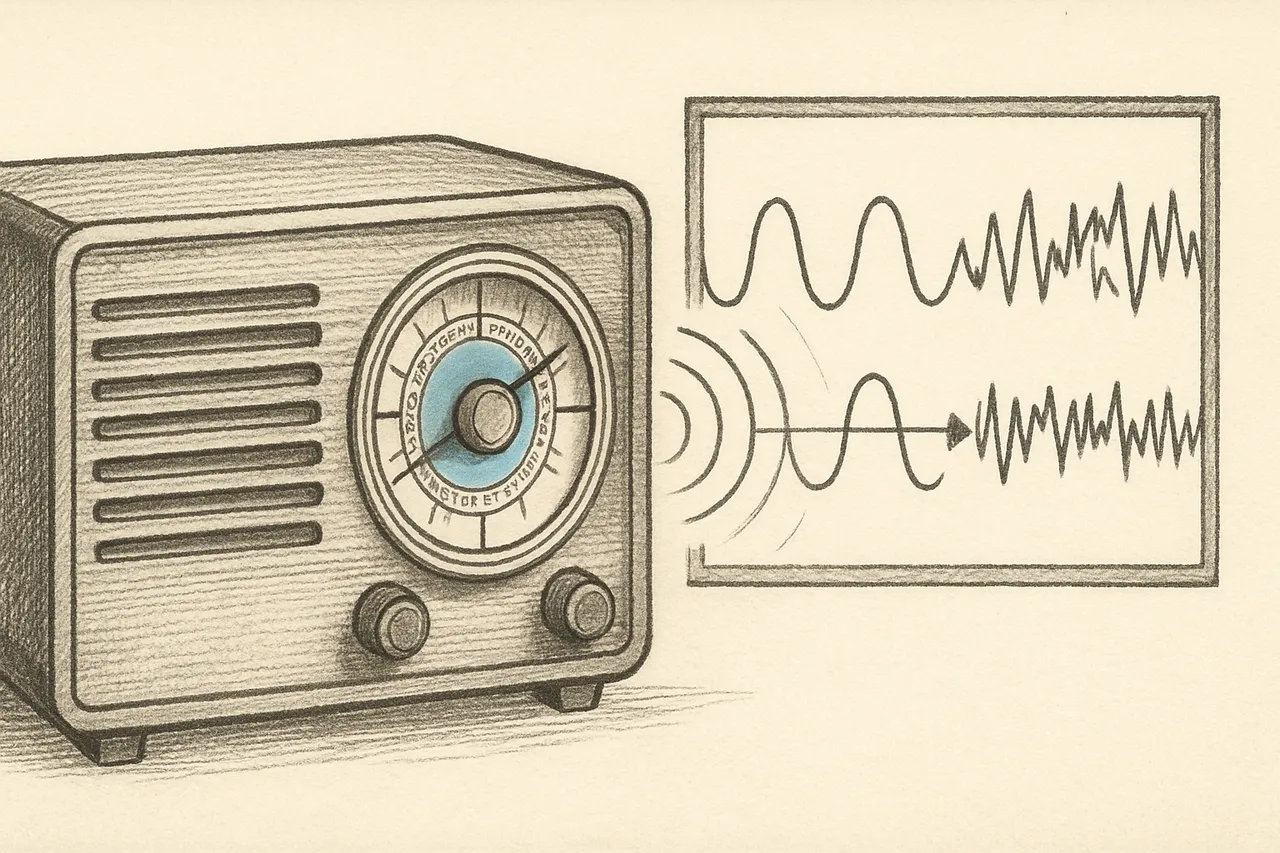
Edwin Armstrong Invented Static-Free Radio. Then the Industry He Threatened Destroyed Him.
FM radio was better than AM in every way — no static, higher fidelity, less power. That was exactly the problem. The company that dominated AM spent two decades in court to bury it, and the inventor spent his fortune fighting back before jumping from his apartment window.
Read the story →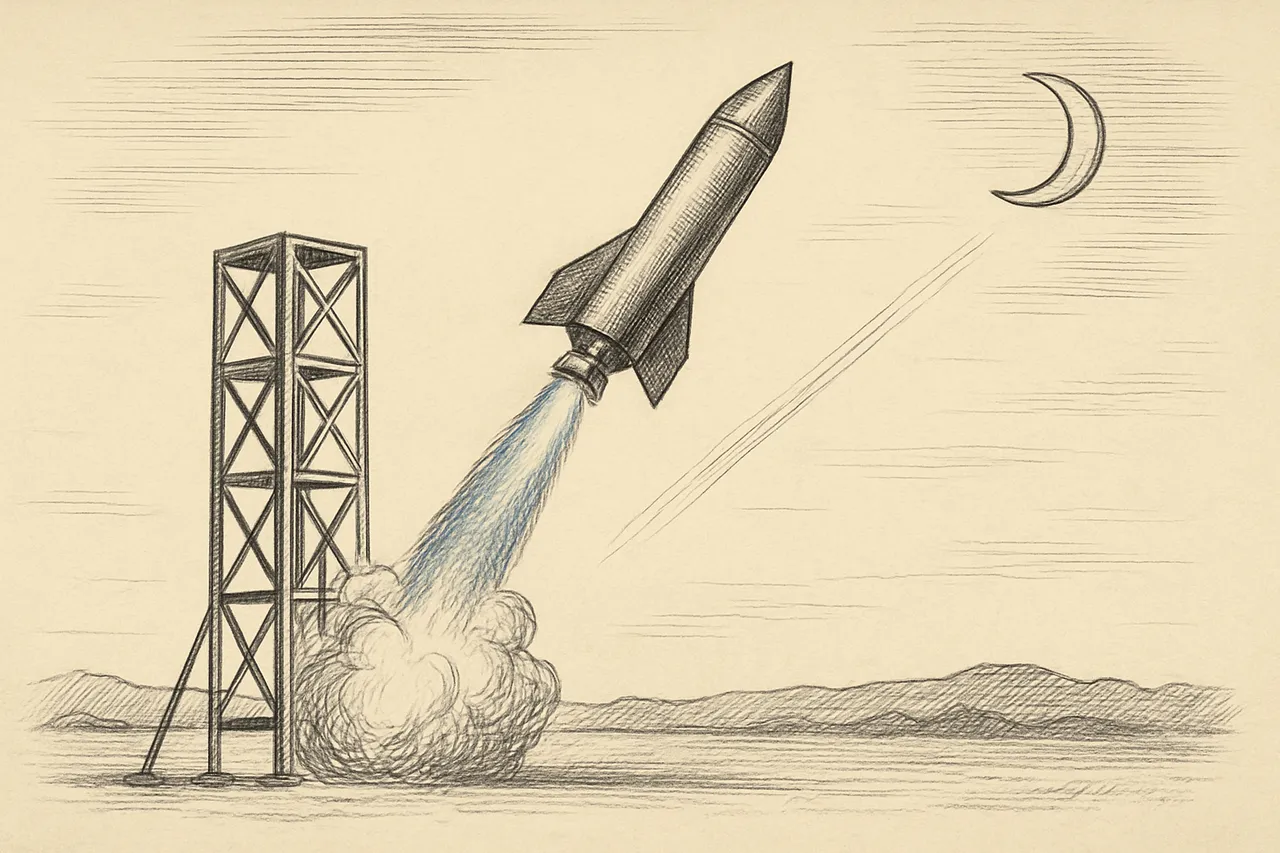
The New York Times Mocked Goddard's Rocket. It Apologized 49 Years Later — Mid-Flight to the Moon.
Robert Goddard patented the fundamentals of the liquid-fuel rocket in 1914. When he suggested a rocket could reach the Moon, a newspaper editorial declared he lacked 'the knowledge ladled out daily in high schools.' The correction ran during Apollo 11.
Read the story →
Chester Carlson Invented the Photocopier. Twenty Companies Said No.
A patent attorney tired of copying documents by hand invented dry photocopying in his kitchen in 1938. IBM, Kodak, GE, RCA, and the US Navy all turned it down. The company that finally said yes became Xerox.
Read the story →