Abraham Lincoln Is the Only President Who Ever Held a Patent. It Was for Lifting Stranded Boats.
Lincoln spent his youth getting boats unstuck. In 1849, weeks after leaving Congress, he applied for a patent on inflatable chambers that would lift a vessel over a sandbar. It was never built, and no other president has held a patent.

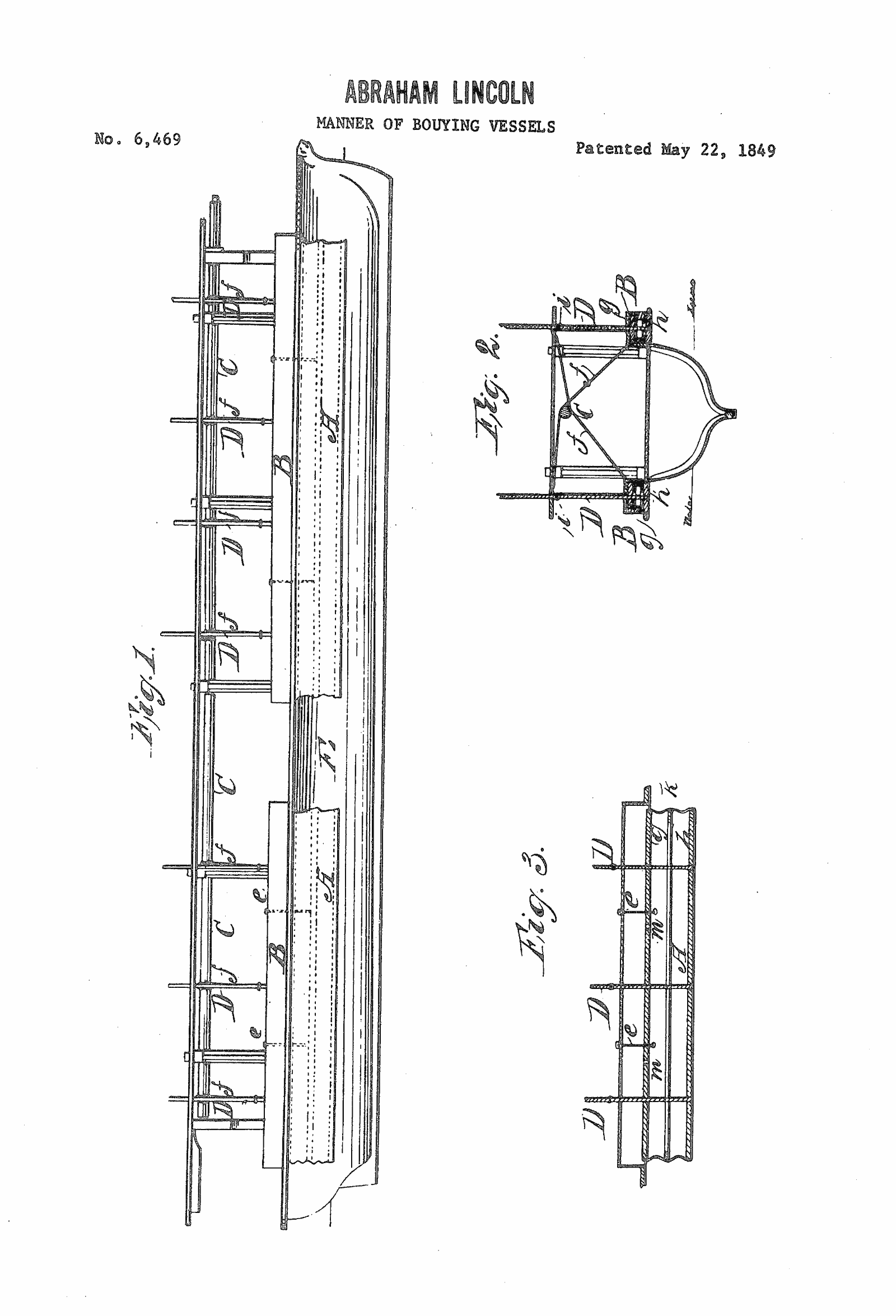
US6469 was filed on March 10, 1849, and granted on May 22, 1849, to Abraham Lincoln of Springfield, Illinois. The title is "Buoying Vessels Over Shoals." Lincoln was 40, and his single term in Congress had just ended. He remains the only United States president to hold a patent.
The idea came from experience. In 1831 Lincoln took a flatboat down the Sangamon River for the merchant Denton Offutt, and it hung up on a milldam. He unloaded cargo, bored a hole in the bow to let the water out, and got the boat over. His law partner William Herndon later described another episode, in 1848, when a steamboat Lincoln was on ran aground on a shoal and had to be worked free with barrels, boxes and planks.
Western rivers shifted constantly, and a boat that could not cross a bar could lose days or its whole cargo. Lincoln had seen the problem from both ends.
Bellows on a steamboat
The patent describes a set of expanding air chambers mounted along the sides of a vessel. Each has a top and bottom of plank or metal, and sides of india-rubber cloth or another waterproof fabric, so it folds up small when not in use.
Spars run down through each chamber and are fastened to its bottom. Ropes connect the spars to a main shaft running the length of the boat under the upper deck. Turn the shaft one way and the chambers are forced down into the water, expanding and filling with air as they go. The added buoyancy lifts the boat. Turn the shaft the other way and the chambers fold back up under the guards.
It could run off the steam engine or by hand, and sections of the shaft could be uncoupled so that one pair of chambers worked alone. The point, in Lincoln's words, was to let a boat pass over bars or through shallow water "without discharging" its cargo.
He signed it "A. Lincoln," and he was careful in the usual lawyerly way, adding that he did not mean to limit himself to any particular mechanical arrangement.
The model
Lincoln worked on a model with a Springfield mechanic named Walter Davis and took it to Washington. It is now in the collections of the Smithsonian Institution, which also keeps a replica because the original is too delicate to lend.
No boat was ever fitted with his chambers. A Smithsonian curator, Paul Johnston, concluded that the design was impractical, because it would have taken too much force to operate.
What he did with the idea
The patent went nowhere, but Lincoln kept thinking about patents. In a lecture on discoveries and inventions delivered at Illinois College in Jacksonville on February 11, 1859, he listed the patent laws among the great advances in human history. The system, he said, gave an inventor exclusive use for a limited time and so "added the fuel of interest to the fire of genius." The line is carved on the Department of Commerce building in Washington.
So the one president with a patent also wrote one of the best sentences anyone has produced about why patents exist, ten years after his own failed to go anywhere.
See the original
The full text and figures of US6469 are on Google Patents.
Related stories

A Lawyer Patented the Automobile Without Building One. Henry Ford Refused to Pay.
George Selden filed for a gasoline road engine in 1879, then kept the application alive for 16 years until there was an industry to tax. Nearly every American carmaker paid up. Henry Ford fought him for eight years and won on a technicality about engines.
Read the story →
Einstein Patented a Refrigerator With No Moving Parts After Reading About a Family Killed by Theirs
In the 1920s home refrigerators could leak poisonous gas. Albert Einstein and Leo Szilard answered with a design that had no pump and no seals to fail, ran on heat alone, and earned them 45 patents in six countries. Freon and the Depression killed it.
Read the story →
The Fire Hydrant Patent Was Destroyed in a Fire
Frederick Graff is usually credited with the post hydrant around 1801. Nobody can check, because the Patent Office burned to the ground in 1836 and took roughly ten thousand patents with it, including his.
Read the story →
Bubble Wrap Was Invented as Wallpaper. Nobody Bought It.
Two engineers sealed two shower curtains together and trapped air bubbles between them. They were trying to make textured wallpaper. That failed. So did their second idea, greenhouse insulation. Then IBM shipped a computer.
Read the story →